If you run e-commerce or merchandising at a high-volume apparel brand on Shopify Plus, your product-image pipeline is almost certainly the thing standing between a finished assortment and a live PDP. The garments are made, the copy is written, the launch date is set — and everything waits on the studio calendar. AI product photography for Shopify Plus exists to take that bottleneck out of the critical path without sacrificing the brand standard your customers recognize.
This is a practitioner's guide, not a pitch. It is written for the operator who has already felt the SKU-shot treadmill: the sample logistics, the re-shoots, the color-approval rounds, the seasonal crunch where the photography queue decides which SKUs make the drop. Below is how AI product photography actually plugs into a Shopify Plus operation, where it compresses cost, and how to evaluate it before you put a full catalog behind it.
Why Shopify Plus fashion catalogs break the studio model
Shopify Plus is built for merchants operating at volume — high SKU counts, frequent drops, multiple storefronts and markets. Shopify Plus merchants tend to refresh assortments faster than a traditional studio pipeline can shoot them, which is where the imagery bottleneck becomes a growth constraint rather than a line item.
Fashion makes the problem worse than most categories. Apparel needs on-model imagery, not just flat lays. On-model means casting, scheduling, fittings, and re-shoots — the most expensive and least predictable part of a shoot. Add size-inclusive representation, multiple colorways per style, and seasonal turnover, and the per-SKU production burden compounds. The result is familiar: merchandising rations photography, low-velocity SKUs launch with a single flat image, and the catalog's visual quality becomes uneven exactly where conversion is most sensitive to it.
Product imagery is not decoration on a fashion PDP — it is the primary decision surface. Research from the Baymard Institute consistently finds that insufficient or inconsistent product imagery is a leading driver of PDP abandonment and returns. On a Shopify Plus catalog moving thousands of SKUs a season, uneven imagery is not a cosmetic issue; it is a measurable drag on conversion and return rate.
What AI product photography actually replaces
The mistake most cost comparisons make is treating AI product photography as a cheaper camera. It is not. It replaces a workflow. A Brand DNA-trained pipeline generates PDP-ready imagery from CAD files, technical flats, or a small set of reference shots — typically two to four per SKU — which means the physical sample never has to ship to a studio for the SKU-shot tier at all.
Concretely, for a Shopify Plus fashion merchant that removes three things from the critical path: sample logistics (vendor coordination, receipt, tagging, return shipping), studio time and space, and most of the retouching queue. What remains is creative direction — someone still decides what the catalog should look like — and a render-review step that is faster and cheaper than traditional retouching. The garments still get photographed to the brand standard; the difference is that the standard lives in a trained model instead of in a photographer's head and a studio's lighting rig.
Because the output is generated rather than captured, the same garment source can produce colorway variants, background swaps, and angle variants without re-shooting — and it can produce on-model apparel imagery across model and size variations that would each require separate casting and studio time in a live shoot. That is where the economics stop being incremental and start being structural.
Brand fidelity at catalog scale: the real objection
Every serious apparel operator's first objection is the right one: will AI-generated images actually look like my brand across thousands of SKUs, or will they drift? Drift is the failure mode that makes AI imagery unusable at catalog scale, and it is precisely what Brand DNA technology is built to prevent.
Before any production run, the model is trained on the brand's existing catalog — its color science, the way its fabrics drape and catch light, its lighting language, its styling conventions. That training pass is what keeps output inside the brand standard SKU after SKU rather than producing a thousand plausible-but-off images. In enterprise apparel production, this pipeline holds 98% texture accuracy across full-catalog runs at a standard three-day turnaround per batch.
The fidelity discipline is not limited to apparel. The same Brand DNA engine has held brand-faithful output for a furniture manufacturer that shipped 19 product-animation videos from a single CAD source — an object category where material realism (grain, weave, upholstery sheen) is unforgiving. Brand fidelity that survives furniture upholstery and jewelry refraction is the same discipline that keeps an apparel catalog on-brand at scale. If you want to see how that same model extends past flat imagery, the virtual try-on and 3D solution pages show where a Shopify Plus catalog can go once the visual pipeline is generative rather than photographic.
The cost math for a Shopify Plus operation
Benchmark AI against the all-in studio cost, not the photographer's invoice. At enterprise scale, per-SKU studio cost lands in the $40-$80 band once you include sample logistics, studio amortization, retouching, color management, and the merchandising-ops time spent coordinating shoots — and the photographer fee alone undercounts real cost by 30-50%.
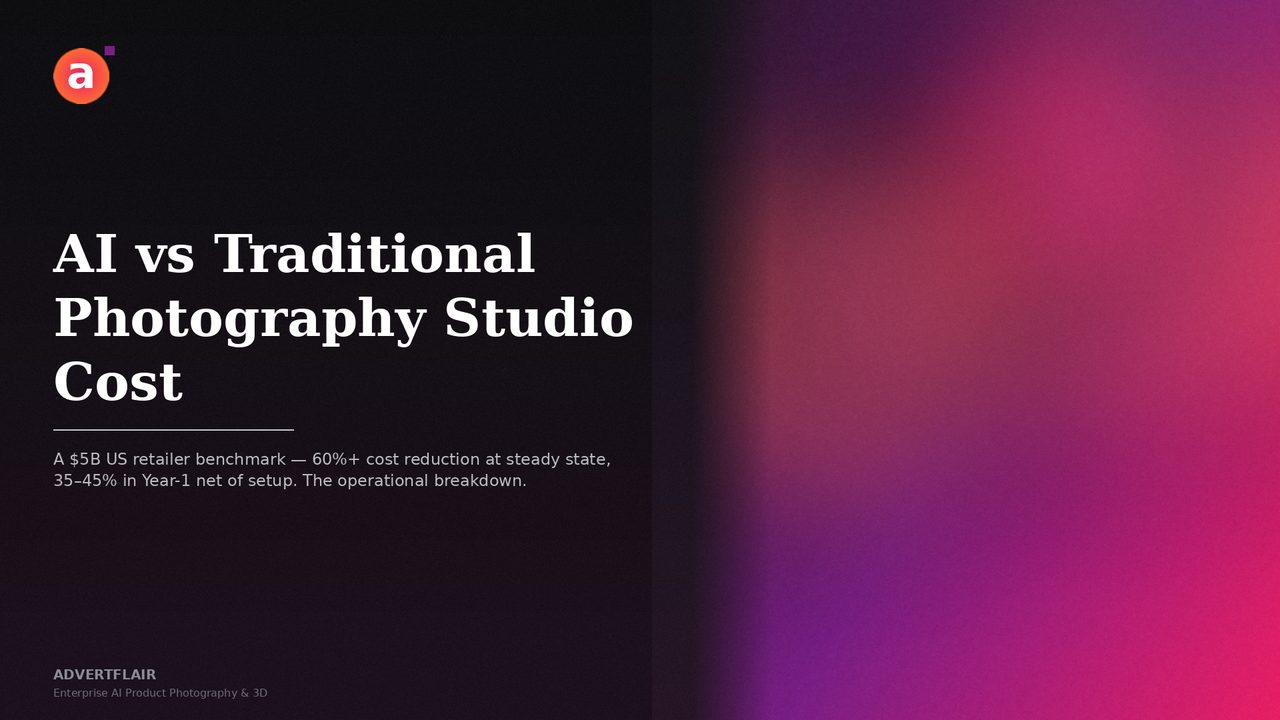
Against that all-in denominator, a Brand DNA AI pipeline runs comfortably below the lower bound at scaled volume. In extended enterprise engagements the pattern is consistent: roughly 35-45% cost reduction in Year-1 net of the setup work (the initial Brand DNA training pass and accuracy calibration), and 60%+ in steady-state Year-2. For a Shopify Plus merchant, the more important number is often velocity, not cost — a three-day batch turnaround means the photography queue stops deciding which SKUs make the drop. Before you model anything, derive your own real per-SKU number: last twelve months of total photography spend, divided by unique SKUs photographed, not shots. That is the figure to walk into the comparison with.
How to plug it into a Shopify Plus workflow
Operationally, AI product photography sits upstream of Shopify. Renders are produced to spec, reviewed by merchandising, and pushed into your DAM or straight into Shopify product records the same way studio assets are today — the storefront does not know or care how the image was made. The images are standard web-optimized files; there is no runtime dependency, no app to install on the storefront, nothing that touches page speed.
The highest-leverage rollout is not "replace everything at once." It is to route the repeatable SKU-shot tier — colorway variants, standard on-model shots, catalog basics — through the AI pipeline, and reinvest the freed studio budget into the hero and campaign work where a human-directed shoot still earns its cost. That is what enterprise merchants consistently do with the savings: a national apparel retailer we ran a controlled year-long benchmark against did not pocket the difference, they moved it into richer PDP experiences, lifestyle work, and 3D product views for their Amazon listings. The cost saving is the unlock; the catalog enrichment is the win.
How to evaluate a vendor before committing your catalog
Five questions separate a real AI product photography partner from a demo. First: what are you measuring savings against — the photographer fee or the all-in studio cost? Second: what is included in the platform fee (Brand DNA training, render review, DAM integration) and over what term? Third: what is your Year-1 versus steady-state savings figure — and if they are the same number, how are setup costs being absorbed? Fourth: what is your accuracy-benchmark methodology — can you cite a blind A/B against my existing catalog with a merchandising-led sort? Fifth: what does a scoped pilot get me?
That last one is the fastest filter. A fixed-fee pilot lets your merchandising team score Brand DNA-trained output against your current work on a benchmark you set, before any catalog-scale commitment. A vendor who only sells at enterprise contract level and cannot offer a scoped pilot is usually a vendor avoiding having their output evaluated against a real accuracy bar. You can pressure-test the fit for a Shopify Plus fashion catalog on the AI photography for fashion page, or start with a scoped pilot and judge the results against your own studio work.
Frequently asked questions
What is AI product photography for Shopify Plus brands?
It is a production pipeline that generates catalog and on-model imagery from CAD files, flats, or a small set of reference photos instead of a physical studio shoot. New SKUs get PDP-ready, brand-faithful images without shipping samples to a studio — typically at a three-day turnaround per batch and a fraction of studio cost, with a Brand DNA model holding every render inside the brand standard.
Will AI-generated images match my brand's look across thousands of SKUs?
That is the failure mode Brand DNA technology exists to prevent. The model is trained on your existing catalog — color science, fabric behavior, lighting language, styling conventions — before production, so output stays inside the brand standard at catalog scale. In enterprise apparel production, this pipeline holds 98% texture accuracy across full-catalog runs.
How much does AI product photography cost compared to a studio for a Shopify Plus catalog?
Measured against all-in studio cost — photographer fee, sample logistics, retouching, color management, and overhead — AI runs below the lower bound of the industry per-SKU band at scaled volume. Enterprise merchants typically see 35-45% cost reduction in Year-1 net of setup and 60%+ in steady state, scaling with the size of the SKU-shot operation being absorbed.
Can AI product photography handle on-model apparel and size-inclusive ranges?
Yes — on-model is one of the highest-leverage uses for apparel because casting, scheduling, and re-shoots are the most expensive part of a live shoot. AI on-model imagery renders the same garment across model variations and size-inclusive representations from one garment source.
How do I evaluate AI product photography before committing my whole Shopify Plus catalog?
Run a scoped pilot. A fixed-fee pilot — Advertflair starts at a $499 five-SKU pilot — lets merchandising score Brand DNA-trained output against your current studio work on a benchmark you set, before any catalog-scale commitment.
About the author
Hari Gurusamy is the founder and CEO of Advertflair, the enterprise AI product photography platform. Hari led the company's pivot from a 145-person 3D services firm to a 25-person AI platform serving enterprise retailers, luxury and fine-art brands, prestige fragrance houses, and consumer-logistics companies. Background in aerospace engineering, mathematics, and an MBA. Connect on LinkedIn →