


If you run e-commerce content at a footwear or athletic apparel brand, your photography problem is structurally worse than almost anyone else's. A running shoe ships in 14 colorways. A legging line ships in 9 colors across 6 sizes with seasonal drops every 8 weeks. Every SKU needs on-model, flat-lay, detail, and lifestyle shots — and the performance fabrics that define your category (engineered mesh, ripstop, brushed interlock, heathered knits) are exactly the textures that cameras, and until recently AI, struggled to reproduce faithfully.
The result is a content treadmill: studios booked out weeks ahead, samples couriered between continents, and a cost-per-image line that your CFO circles every quarter. McKinsey's State of Fashion work has tracked the same pressure across the industry — content volume requirements keep climbing while marketing budgets don't.
This guide covers what changed in AI product photography for this category, what an 18-month enterprise deployment actually proved, and how to run a low-risk pilot this quarter.
Why footwear and athletic apparel are the hardest photography categories
Three structural problems make this vertical the stress test for any photography pipeline:
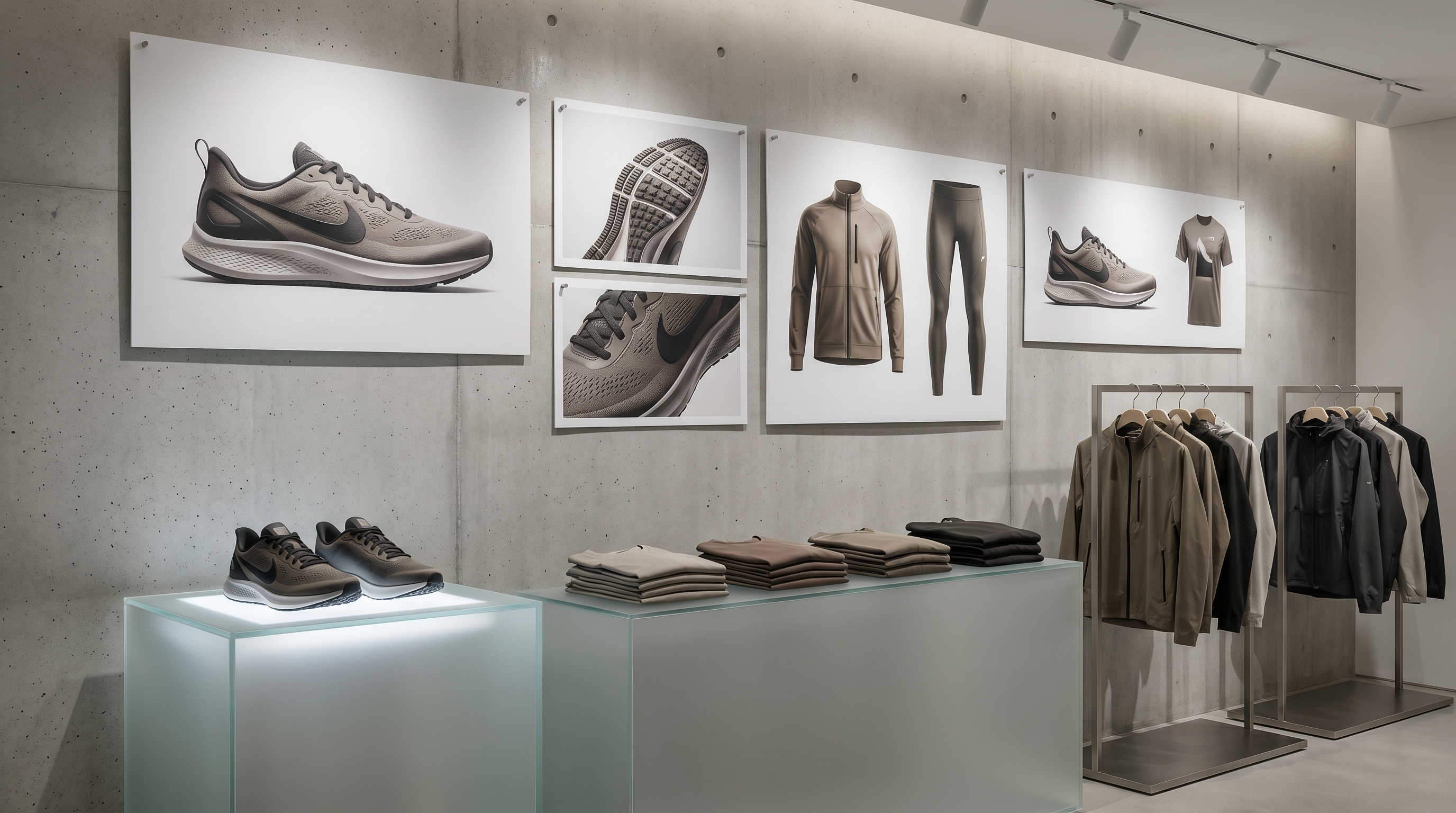
Texture is the product. A buyer choosing between two trail runners is reading the mesh density, the overlay stitching, the outsole lug pattern. If your imagery softens or hallucinates those textures, the photo isn't just unattractive — it misrepresents the product and drives returns. This is why early-generation AI imagery failed in this category: it couldn't hold fabric truth at zoom.
Colorway math is unforgiving. Fourteen colorways times eight angles times two contexts is 224 images for one silhouette. Traditional studios price per shot; the math punishes exactly the brands with the deepest catalogs.
Seasonal velocity compresses everything. Athletic brands run more drops per year than almost any other category. An 8-to-12-week studio cycle means imagery becomes the launch bottleneck — a problem any team that has slipped a drop date over photography knows intimately.

The benchmark: 18 months inside a $5B US retailer
The most useful dataset we can offer isn't a lab demo — it's production history. Advertflair has operated as the AI product photography pipeline behind Dillard's, the $5B US department store retailer, for over 18 months, processing apparel and footwear imagery at full catalog scale. Three numbers from that deployment define what enterprise-grade means in 2026:
98% texture accuracy. Measured against studio reference photography, the AI pipeline holds fabric texture — knit structure, drape, sheen — at a fidelity level that survives merchandiser review. This is the single number that separates production-grade systems from demo-grade ones, and it's the first thing to test in any pilot.
3-day turnaround. From product reference to retouched, channel-ready imagery. Against an 8-to-12-week traditional studio cycle, that converts photography from a launch bottleneck into a same-sprint deliverable.
60% cost reduction. At catalog scale, against fully loaded studio costs (studio time, samples logistics, models, retouching). The savings compound with colorway depth — which is why footwear and athletic apparel see the steepest curve of any vertical we serve.
The full fashion-vertical breakdown lives on our AI solutions for fashion and apparel page.
Brand DNA: how AI stays brand-faithful across 200 colorways
The standard objection from creative directors is fair: "AI imagery looks like AI imagery." Generic models drift — lighting shifts between batches, shadows behave differently across colorways, and the catalog stops looking like one brand shot it.
The answer is what we call Brand DNA: training the system on your existing brand photography so that lighting logic, shadow behavior, model direction, and color treatment are learned constraints, not per-image prompts. Practically, that means colorway 14 renders under the same lighting physics as colorway 1, and the Spring drop matches the visual system of the Fall drop without a creative director re-briefing a studio.
For performance fabrics specifically, the pipeline works from your actual product photography as ground truth — the compositing approach keeps the real fabric structure and generates the context around it. The same method handles the highest-stakes detail work in our jewelry vertical, where stone facets and metal sheen punish any system that invents detail.

How a footwear or athletic catalog actually makes the shift
No enterprise team should move its catalog on faith. The deployments that work follow the same three-step pattern:
Step 1 — Pilot on your hardest SKUs (week 1-2). Pick 10 SKUs that represent your most difficult textures: an engineered-mesh runner, a heathered fleece, a reflective shell. A pilot on easy SKUs proves nothing. Our standard pilot is $2,000 for 10 SKUs, deliberately priced so the decision is a line-item, not a procurement cycle.
Step 2 — Merchandiser-grade review (week 2-3). Put AI output next to studio reference and let your merchandising and creative teams review blind. The 98% texture-accuracy bar means the conversation moves from "can you tell?" to "which 2% needs a reshoot rule?"
Step 3 — Scale by collection, not big-bang (month 2+). Move one collection or one channel (e.g., marketplace listings) first, keep your studio relationship for hero campaign work, and expand as the QA data accumulates. The 3-day cycle means you can run AI and studio pipelines in parallel without scheduling conflict.
Brands on Shopify Plus and similar enterprise commerce platforms typically wire delivery straight into their DAM or PIM — the imagery arrives channel-sized for PDP, marketplace, and social crops in one pass.
AI vs. traditional studio: the honest split for athletic brands
AI product photography in 2026 does not replace everything, and vendors who claim it does should worry you. The split that holds across our enterprise deployments:
AI wins: colorway extension (shoot one, render thirteen), marketplace and PDP imagery at catalog scale, seasonal refresh of evergreen SKUs, on-model variation across body types and contexts, and speed-critical drop support.
Studio wins: hero campaign creative, athlete and ambassador shoots, motion work, and the handful of flagship images that anchor a season's brand story.
Most athletic brands land at roughly 70-80% of image volume through the AI pipeline and 20-30% through traditional production — with the studio budget reallocated toward the creative work that actually needs it. The vertical-by-vertical picture is on our AI solutions hub.
Frequently asked questions
How accurate is AI product photography for technical fabrics like mesh and knit?
Production-grade systems hold 98% texture accuracy against studio reference, measured across an 18-month deployment at a $5B US retailer. The key is a compositing approach that works from your real product photography rather than generating fabric from scratch — test this with your hardest textures in a blind merchandiser review before committing.
What does AI product photography cost for a footwear catalog?
Enterprise deployments at catalog scale run roughly 60% below fully loaded studio costs, with the savings steepest for deep-colorway catalogs. Entry is deliberately low: a 10-SKU pilot is $2,000, and transparent pricing scales from there by volume.
How fast can AI imagery support a seasonal drop?
Standard turnaround is 3 days from product reference to channel-ready imagery, against 8-12 weeks for a traditional studio cycle. For drop-driven athletic brands, that converts photography from the launch bottleneck into a same-sprint deliverable.
Will AI imagery look consistent with our existing brand photography?
Only if the system is trained on your brand's photography — lighting logic, shadow behavior, and color treatment — rather than prompted per image. This Brand DNA approach is what keeps colorway 14 visually identical in treatment to colorway 1 and keeps new drops consistent with last season's catalog.
Should we move our whole catalog to AI photography at once?
No. The deployments that succeed pilot on the 10 hardest SKUs first, run blind merchandiser review against studio reference, then scale collection by collection. Keep traditional studio production for hero campaign and athlete work — the right enterprise split is typically 70-80% AI, 20-30% studio.
Where to start
If your team is heading into a Fall planning cycle with the same studio math as last year, run the 10-SKU test before you re-sign it. Start a $2,000 pilot now → — pick your 10 hardest SKUs and have merchandiser-reviewable imagery back in 3 days. Prefer to talk it through first? Book a quick consultation.
About the author: Hari Gurusamy is the CEO of Advertflair, the enterprise AI product photography and 3D platform behind 18 months of production imagery at Dillard's, plus Crozier Fine Arts, Torani, Veronique Gabai, and MBM Chairs. Aerospace engineer by training, Brooklyn-based, building the pipeline that lets retail content teams ship imagery at the speed their catalogs demand.

