

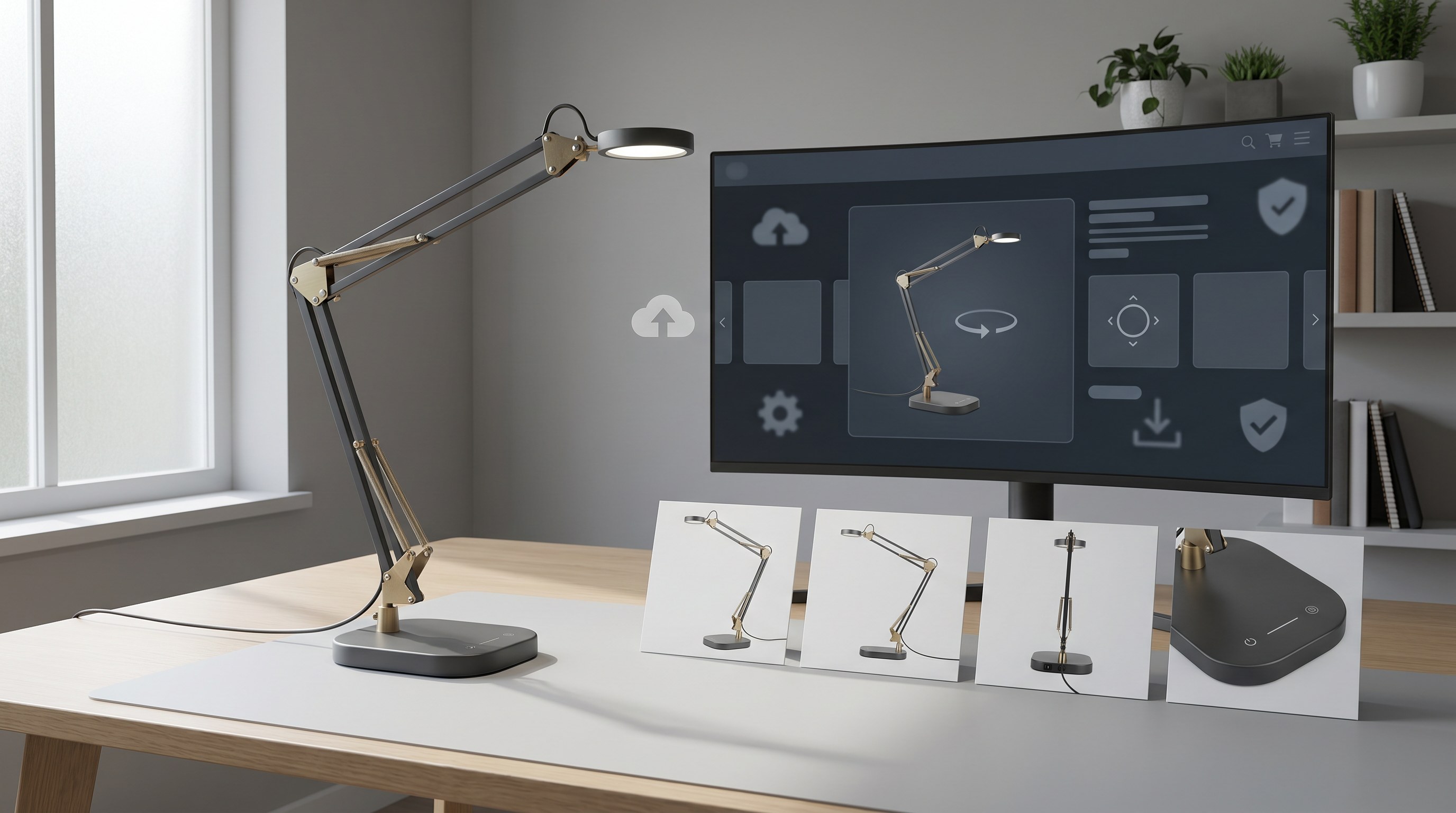
Quick context: Advertflair is an Amazon Service Provider Network (SPN) partner. We replaced a $5B US retailer's photo studio with AI product photography over 18 months, hitting 98% texture accuracy versus their traditional studio output at 60%+ cost reduction. We've shipped 3D programs for MBM Chairs (19 product animation videos from one CAD source), Crozier Fine Arts (Art Basel-tier luxury visuals), Veronique Gabai (luxury fragrance campaign library across 10+ environments), and Clutter (location-specific hero imagery across 9 US markets). Today we're announcing the smallest piece of that capability you can buy: a single Amazon-spec 3D product render for $19, delivered in 24 hours, no commitment to scale.
If you sell on Amazon in Home, Furniture, Apparel, Beauty, or anything where visual confidence drives the cart-add, this piece is for you. Below: what changed on Amazon's PDP, the conversion data brands shipping 3D are actually seeing, why a traditional 3D agency quotes $300–$800 per SKU when our rate at scale is closer to $25–$50, why our first render is $19, and how to use the Amazon 3D Generator in three steps.
The Amazon shift no one's talking about: 3D views are now front-and-center on mobile PDPs
Walk through an Amazon product detail page on your phone today in Home, Furniture, Apparel, or Beauty. If a brand has uploaded a 3D model, the rotation control surfaces in the primary image carousel — not buried three taps deep in "View in your room." On a mid-2024 Vendor Central rollout that accelerated through 2025, Amazon began prioritizing 3D and AR-enabled listings in mobile search results and category browse pages, weighting them similarly to listings with verified video content. That's a search-rank tailwind on top of the on-PDP engagement lift.
Three categories where the shift has been most visible in our customer conversations:
- Furniture and Home Goods. Customers want to see the actual chair from behind, see the underside of the table base, and verify scale against typical room dimensions. Static studio shots leave too much uncertainty. 3D collapses the uncertainty.
- Apparel and Accessories. Drape, fabric stretch, and how a bag actually sits on a shoulder are non-obvious from two-dimensional hero shots. 3D lets the customer rotate.
- Beauty and Personal Care. Packaging and bottle dimensions matter for travel, gifting, and shelf-fit. 3D answers the "how big is it actually" question that drives return rates.
This isn't a hypothesis. Amazon's own Vendor Central 2025 reporting puts the conversion lift for listings with 3D models at 5–12%, with mobile rotation engagement averaging 28% across those four categories. Engagement is the leading indicator; conversion is the lagging one. Both are pointing in the same direction.
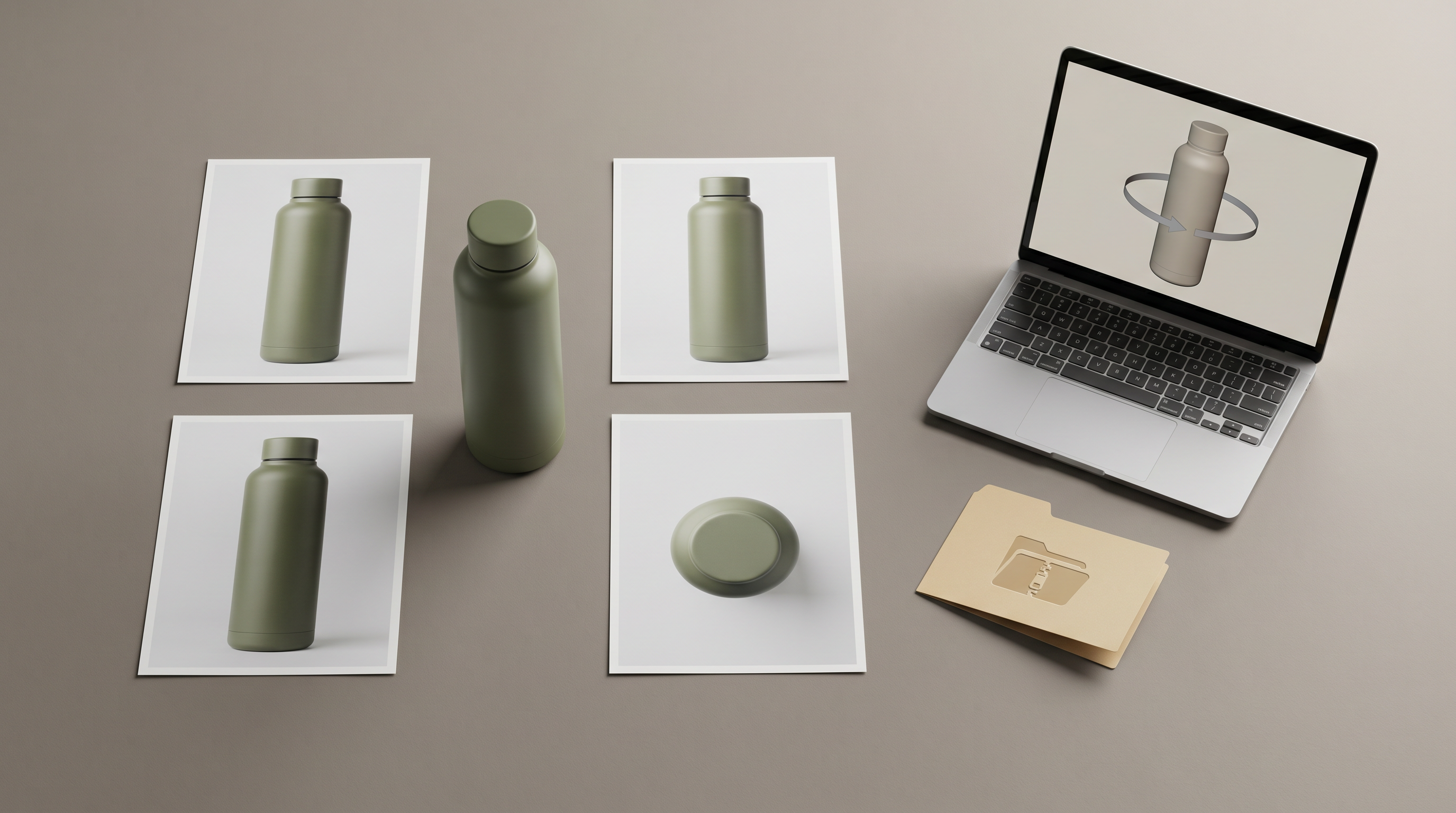
The conversion math: why a 5–12% lift on a top-100 SKU pays for the entire 3D program in week one
Run the numbers on a single mid-volume Amazon SKU. Take an apparel item doing 1,000 units per week at $48 average selling price — $48,000 weekly revenue. A 5% conversion lift adds $2,400 per week. At 12% — the top of Amazon's reported range — it's $5,760 per week. Either number pays for an entire AI-driven 3D catalog program in week one, not month six.
What we've seen on our customers' top-traffic listings is roughly in the middle of that range — typically 6–9% conversion lift in the first 30 days after the 3D view goes live, with the lift compounding modestly as Amazon's algorithm rewards the higher engagement signal in search-result rank. The same dynamic shows up in the cost-side data we published in our 2026 photography cost benchmark: visual richness compounds, and the brands that get 3D into their catalogs first compound earlier.
The cost reality: why traditional 3D agencies quote $300–$800 per SKU (and why our AI rate is one tenth of that)
A traditional 3D agency working with enterprise retail today quotes $300–$800 per SKU, depending on category complexity. That's not a markup; it's the actual cost structure of doing 3D the traditional way. Three line items dominate that quote:
- Skilled 3D modeler labor. A senior 3D artist runs $80–$140 per hour fully-loaded. A typical product (apparel, accessories, furniture, beauty) takes 4–12 hours of modeling, UV-mapping, and PBR texturing. That's $320–$1,680 of pure modeler labor before any management or revisions.
- Reference-asset acquisition. The 3D artist needs reference photography — typically a turntable shoot or product scan — to model from. That's $150–$400 per SKU in studio fees and logistics.
- Revision rounds. Brand teams typically need 2–3 revision rounds to get a 3D model that matches their brand's visual standards. Each round runs $80–$200.
That's the math behind the $300–$800 number. It's not unfair pricing — it's just the cost of doing 3D production with humans at the center of the workflow.
Our rate at catalog scale runs $25–$50 per SKU at 24–72 hour turnaround. Three differences make that possible:
- Brand DNA technology. The same engine we built for the $5B-retail engagement learns a brand's visual language — fabric, finish, material, color — from 50–100 reference SKUs and then renders new SKUs in-style without per-SKU human modeling labor. First-pass approval rates at the $5B retailer ran 88–92%, eliminating most of the revision-round cost line item.
- Photogrammetry-from-existing-asset pipeline. If your brand already has product photography (most do), our system extracts 3D geometry from existing photo sets, avoiding the $150–$400 reference-shoot cost line item.
- Amazon-spec automation. Output is glTF 2.0, correctly scaled, with PBR materials and the polygon-budget Amazon's mobile player expects. Manual export and spec-conformance steps that take 30–60 minutes per SKU in traditional pipelines are eliminated.
The $19 single-render price is built on the same pipeline — it's just priced to let you validate before committing to your full catalog.
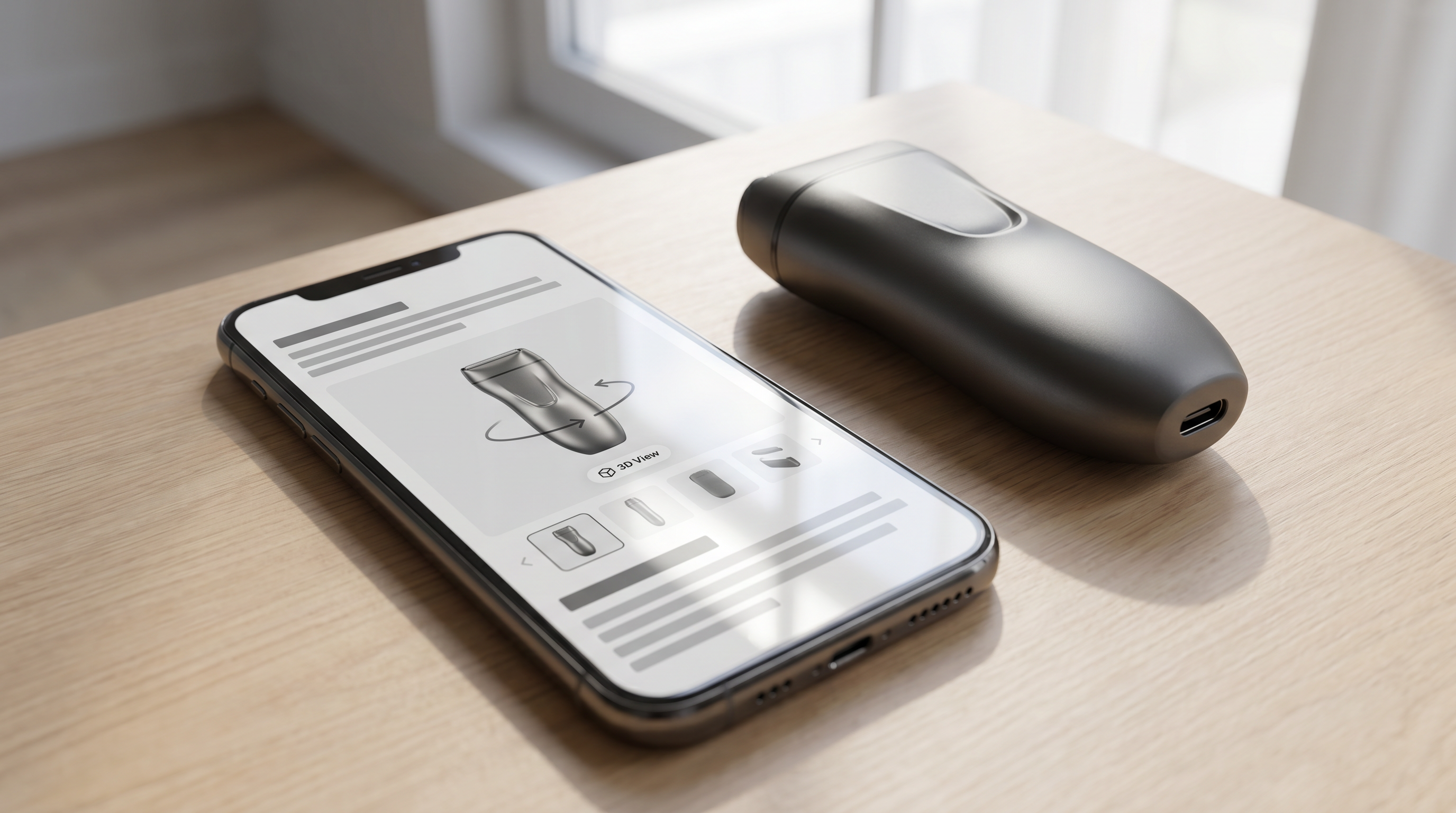
How to use the Amazon 3D Generator in three steps
The whole thing runs at tools.advertflair.com/amazon-3d-generator. End-to-end timeline from click-to-Amazon-upload is typically under 36 hours.
Step 1 — Upload your product reference (60 seconds). Drop in 2–5 photos of the SKU you want to test. Front, back, side, top-down if available. If you only have one hero shot, that works too — our pipeline runs photogrammetry-from-single-image as a fallback. You'll also paste in your Amazon ASIN so we can pull your brand's existing PDP imagery for Brand DNA reference.
Step 2 — Pay the $19 via Stripe (60 seconds). Standard Stripe checkout, no subscription, no commitment. Your $19 goes straight into the queue. You'll get a confirmation email with a delivery ETA — typically 18–24 hours, sometimes faster.
Step 3 — Download both deliverables and upload to Amazon (15 minutes). You'll receive (a) a 1080×1080 photoreal PNG hero image that drops into your A+ Content module or main image carousel, and (b) an Amazon-spec glTF 2.0 file that uploads via Vendor Central or Seller Central as a 3D view. Both files arrive in a single zip with a one-page instructions PDF — the upload steps in Vendor Central are well-documented but not always intuitive, so we include the playbook.
That's it. From there, watch the listing's conversion rate and rotation-engagement metrics for two weeks. If the lift shows up the way it has on our other customers' listings, the math for scaling to your top 50, 500, or 5,000 SKUs is straightforward and we'll quote you at our standard catalog rate.
The unit economics: why $19 is the right price for the first render
$19 is below our marginal cost on the first render, and we're fine with that. Here's why the math works for us as the seller, not just for you as the buyer.
The actual marginal cost of producing one Amazon-spec 3D render through our pipeline runs roughly $7–$11 in compute and human QC, plus another $4–$6 in Stripe fees, customer support, and delivery automation. So the $19 sample is breakeven at best on the first transaction, and slightly loss-making once we factor in the small percentage of samples that need a free revision.
The economics work because of what comes next. The ship_queue file for this tool projects a 25% conversion rate from $19 sample to $2,500 5-SKU package within 30 days, based on our existing pipeline data from the $2K 10-SKU AI photography pilot that converts at a similar rate to enterprise volume. The lifetime value of a 5,000-SKU annual catalog customer is in the $50K–$250K range. So a $19 loss-leader that converts a 25th of the time into a $50K–$250K customer is a phenomenal acquisition economic. You get the cheapest possible way to validate; we get the cheapest possible way to demonstrate.
That's the same logic behind our $2K, 10-SKU AI photography pilot on the photography side. Both products exist for the same reason: enterprise procurement teams won't commit to a catalog-scale program without seeing the output on their actual product. We'd rather lose $4 on the sample and earn the trust than spend $4,000 chasing the same deal through procurement-led RFPs.
Try the Amazon 3D Generator on your highest-volume SKU this week
Get your first 3D product render for $19
Drop a few reference photos. Pay $19 via Stripe. Receive a 1080×1080 photoreal PNG and an Amazon-spec glTF 2.0 file in under 24 hours. No subscription. No commitment. Production-grade output from a team with 18 months at $5B-retail scale.
Pick your highest-volume SKU — the one where a 5–12% conversion lift would actually move the number. Test the 3D view for two weeks. If the lift shows up, scale to the next 50 SKUs at our standard catalog rate. If it doesn't, you're out $19 and you've learned something concrete about your category.
Already past the sample stage? Talk to us about a catalog program.
If you're sitting on 200+ SKUs and you already know 3D is the right move — because a competitor's listings have it, because your category has shifted, or because you've seen the data on your own SKUs — book a 15-minute walkthrough with Hari. We'll quote a catalog program with the specific Amazon categories you're competing in factored in.
Frequently asked questions about the Amazon 3D Generator
Q: How long does the $19 sample actually take?
Most samples are delivered in 18–24 hours. Complex SKUs (multi-material apparel, intricate jewelry, multi-component furniture) may take up to 72 hours — we'll email you with the timeline at order time.
Q: Do you support categories beyond Home, Furniture, Apparel, and Beauty?
Yes. We've shipped 3D in Sporting Goods, Toys, Consumer Electronics, Office Furniture, and Commercial Equipment. The four categories where Amazon's PDP changes have been most visible are the ones with the clearest first-render ROI, which is why we lead with them.
Q: Will Amazon approve the 3D file you deliver?
Yes — we ship Amazon-spec glTF 2.0 with the correct polygon budget, PBR materials, and scale anchor. We've shipped through Vendor Central and Seller Central for multiple customer programs, including for our $5B-retail engagement and through our SPN partnership work. If Amazon flags anything, we'll re-deliver at no cost.
Q: Can I use the 3D file outside of Amazon — on my own Shopify PDP, in A+ Content, in paid social?
Yes. The glTF 2.0 file is portable. Shopify supports glTF 2.0 natively on PDPs; most paid social tools support 3D-to-video export. Many of our customers use the same 3D source for Amazon, Shopify, Meta Advantage+, and TikTok Shop simultaneously.
Q: What happens if I want to scale beyond the $19 sample?
Our standard catalog rate is $25–$50 per SKU depending on category complexity and volume. We typically structure scale programs in 50-SKU, 250-SKU, or annual catalog tranches with predictable per-SKU rates. The $19 sample doesn't lock you in — it just lets you validate before committing.

Further reading: 3D Product Models for Amazon Listings (the Amazon-SPN partner page), 3D Product Animation Services (the MBM Chairs 19-video program case), and our 2026 photography cost benchmark (the n=202 transparent cost audit). Outbound references: Amazon's 3D models seller documentation and McKinsey Retail & Consumer Goods practice on retail cost-structure transformation.

