

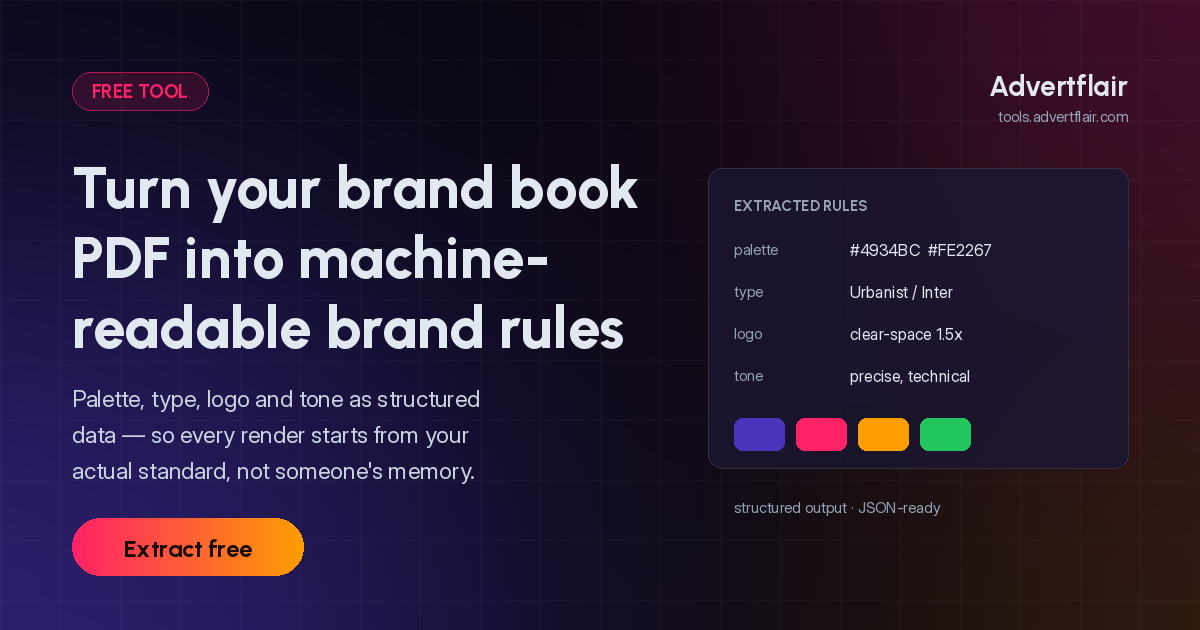
Quick context: Advertflair is the enterprise AI product photography and 3D platform that grew out of replacing the in-house studio of a $5B US retailer — an 18-month engagement that held 98% texture accuracy and cut per-asset cost by 60%-plus versus the retailer's own studio. Everything on that pipeline depends on one input most brands keep locked in a PDF: the brand book. So we built a free tool to unlock it. Extract your brand book free →
Your brand rules are trapped in a PDF nobody can read
Every serious product brand has a brand book: a beautifully designed 40-page PDF that specifies the exact palette, the type hierarchy, the logo clear-space, the photography lighting, and the tone rules that make your catalog look like you. It cost money to produce. And then it goes to die in a shared drive, because the one thing a PDF cannot do is enforce itself.
The result is brand drift. A reshoot comes back a half-shade warm. A new agency guesses at your hero-image framing. A freelancer eyeballs the accent color instead of pulling the exact hex. Across 500 SKUs and a dozen contributors, those small deviations compound into a catalog that no longer looks like one coherent brand — and every buyer comparing two of your product pages sees the seams. The brand book was supposed to prevent exactly this, but a document a human has to read, interpret, and remember cannot govern production at catalog scale. Machines can. They just need the rules in a format they can parse.
That is the entire reason the Brand Book Extractor exists: it turns your static brand-guidelines PDF into machine-readable brand rules — structured palette, type, logo, and tone data — so every downstream tool, render, and reshoot starts from your actual standard instead of someone's best guess.
The data behind why this tool exists
We did not build this from a whiteboard. We built it because brand drift was the single most expensive hidden line in every large catalog program we ran. Industry survey data across catalog photography puts traditional studios at close to 1.8 reshoots per SKU, and in our experience the leading cause is not technical failure — it is brand mismatch. The first pass comes back off-standard because the standard lived in a human's memory of a PDF, not in the pipeline.
When we replaced the $5B retailer's studio, the thing that made 98% texture accuracy and a 60%-plus cost reduction possible was not a better camera — it was encoding the brand's exact standard into the production model so every asset was generated to spec rather than corrected into agreement afterward. The MBM Chairs furniture program is the clearest proof of the pattern: from a single modeled source and one locked brand standard, that engagement shipped 19 brand-faithful animation videos plus a full still-render library — every output consistent because every output came from the same encoded rules, not from re-interpreting a document 19 times.
The Brand Book Extractor takes the first and most tedious step of that process — reading the PDF and turning it into structured data — and gives it away, because a machine-readable brand book is the foundation everything else is built on. Brand consistency is not a nice-to-have: Nielsen Norman Group's research on brand experience shows that consistency across touchpoints is what builds the trust that drives conversion. Inconsistency reads, to a buyer, as carelessness.
How the Brand Book Extractor works: three steps
You do not need a designer, a developer, or a data team. You need the PDF you already have.
Step 1 — Drop in your brand book PDF. Drag and drop your brand-guidelines or style-guide PDF onto the tool. It reads the document the way a human designer would — scanning for the color system, the typography specification, logo-usage rules, and the tone-of-voice guidance — and returns an instant on-screen extraction preview.
Step 2 — Review the extracted rules. The preview shows what it pulled: your palette as exact hex values, your type hierarchy (families, weights, and scale), logo clear-space and misuse rules, and the tone descriptors that govern copy. You confirm it read your brand correctly before anything else happens.
Step 3 — Get the structured export. Enter your email and the tool delivers the full structured extraction — your brand book as machine-readable data (palette, type, logo, and tone as clean key-value rules) ready to feed a design-token system, a production pipeline, or any downstream AI imagery tool. This is the "brand guidelines to JSON" step that lets software finally enforce what the PDF could only describe. If you want to go deeper on the token side, the emerging W3C Design Tokens Community Group standard is where the industry is converging, and the extractor's output maps cleanly onto that model.
Why it is free (and what it unlocks)
A fair question for any tool priced at zero: what is the catch? There isn't one. The Brand Book Extractor is free because a machine-readable brand book is worth more to you — and to us — as an input than as a product. Once your palette, type, logo, and tone rules are structured data, every reshoot, every new render, and every AI-generated image can be governed against your actual standard instead of drifting. That is the compounding value: the drift that used to cost you 1.8 reshoots per SKU collapses when the pipeline starts from encoded rules.
For us, brands that extract their brand book are exactly the brands that benefit most from AI-native production, so giving the first step away is the honest way to prove the model before anyone spends a dollar. If the extraction is useful on its own — plenty of teams just want their brand book as design tokens — keep it, no strings. If it makes you curious what governed AI production looks like across your catalog, the door is open. Either way, the tool does its job on upload.
Where a machine-readable brand book pays off
The extraction is a foundation, not a finish line. Once your brand rules are structured, they feed straight into the production surfaces where drift actually costs you: AI product photography across your catalog, where every render is generated to your encoded palette and lighting; on-model fashion and apparel imagery, where fabric tone and styling have to match the brand book exactly; and luxury and jewelry visuals, where a half-shade of metal warmth is the difference between on-brand and off. The same encoded rules also govern 3D: if you are turning your catalog into AR-ready assets with the catalog 3D twin pipeline, the extracted material and color rules apply automatically to every twin, so 500 SKUs look like one brand instead of 500 slightly-different renders.
This matters more than teams expect, because imagery is how buyers judge you. Product-page research from the Baymard Institute is blunt: shoppers assess product quality primarily through images, and inconsistent or off-brand visuals are a leading driver of product-detail-page abandonment. A brand book that can enforce itself is, in the end, a conversion asset.
Frequently asked questions
What is a brand book extractor, and what does it actually pull from my PDF? It is a tool that reads your brand-guidelines PDF and returns the rules as structured data: your color palette as exact hex values, your typography hierarchy (families, weights, scale), logo clear-space and misuse rules, and your tone-of-voice descriptors. Instead of a document a human has to interpret, you get machine-readable brand rules software can enforce.
How do I turn my brand guidelines into JSON or design tokens? Upload the PDF, confirm the on-screen extraction preview is correct, then enter your email to receive the full structured export. The output is clean key-value brand rules that map onto a design-token model, so you can feed them into a token system, a production pipeline, or any AI imagery tool.
Is the Brand Book Extractor really free? Yes — fully free, no trial clock. A machine-readable brand book is more valuable to everyone as an input than as a paid product. If you only ever use the export to standardize your own design tokens, that is a complete and legitimate use of the tool.
Why does a machine-readable brand book reduce reshoots and brand drift? Because the pipeline starts from your encoded standard instead of someone's memory of a PDF. Traditional catalog work averages close to 1.8 reshoots per SKU, largely from brand mismatch on the first pass. When palette, type, and material rules are structured data, renders and reshoots are generated to spec — the same discipline that let an 18-month $5B-retailer engagement hold 98% texture accuracy at a 60%-plus cost reduction.
What file do I need, and what if my brand book is long? A standard brand-guidelines or style-guide PDF is all you need. Longer, more detailed brand books actually produce a richer extraction, because there are more explicit rules to read. You review everything in the preview before the full export, so you always confirm the tool read your brand correctly.
Extract your brand book — free, in about a minute
Turn your brand book PDF into machine-readable rules → Drop in your PDF, see the extraction preview instantly, and get the structured export in your inbox. No cost, no trial clock — keep the output either way. Want to see what governed AI production looks like across your whole catalog once your brand is encoded? Book a 15-minute consultation → and we will scope it against your actual SKU count and brand standard.
Hari Gurusamy
Founder & CEO, Advertflair (DBA Vela Studio, Glam AI, Style AI)
Hari founded Advertflair in 2016 and led the pivot from a 145-person 3D services firm to a 25-person enterprise AI product photography and 3D platform. The Brand DNA engine he and the team built has run in production at a $5B US retailer for 18 months and across furniture and luxury 3D programs, including the MBM Chairs 19-video animation program. He writes about the unit economics of visual commerce and the shift from service-based creative to productized AI. Connect with Hari on LinkedIn.

