What Brand DNA actually means — and why generic AI product photography models break catalogs at scale

Every enterprise prospect we talk to has seen the demo where someone prompts an AI image model with "luxury silk blouse on neutral background" and the model returns a respectable image. They have also seen what happens at SKU 47, or SKU 247, or SKU 2,470: the catalog drifts. Shadow direction shifts between renders. White balance migrates from warm to cool across what should be a single product family. The drape on the silk reads as plausibly silk on one image and plausibly polyester on the next.

The drift is not a model-quality problem. The drift is a calibration problem. Generic AI product photography models are trained on the internet's photography distribution — every brand, every era, every aesthetic, averaged. The model has no idea what your brand looks like. Asked to produce 10,000 catalog images, it produces 10,000 different brands' imagery, all of which happen to depict your products.

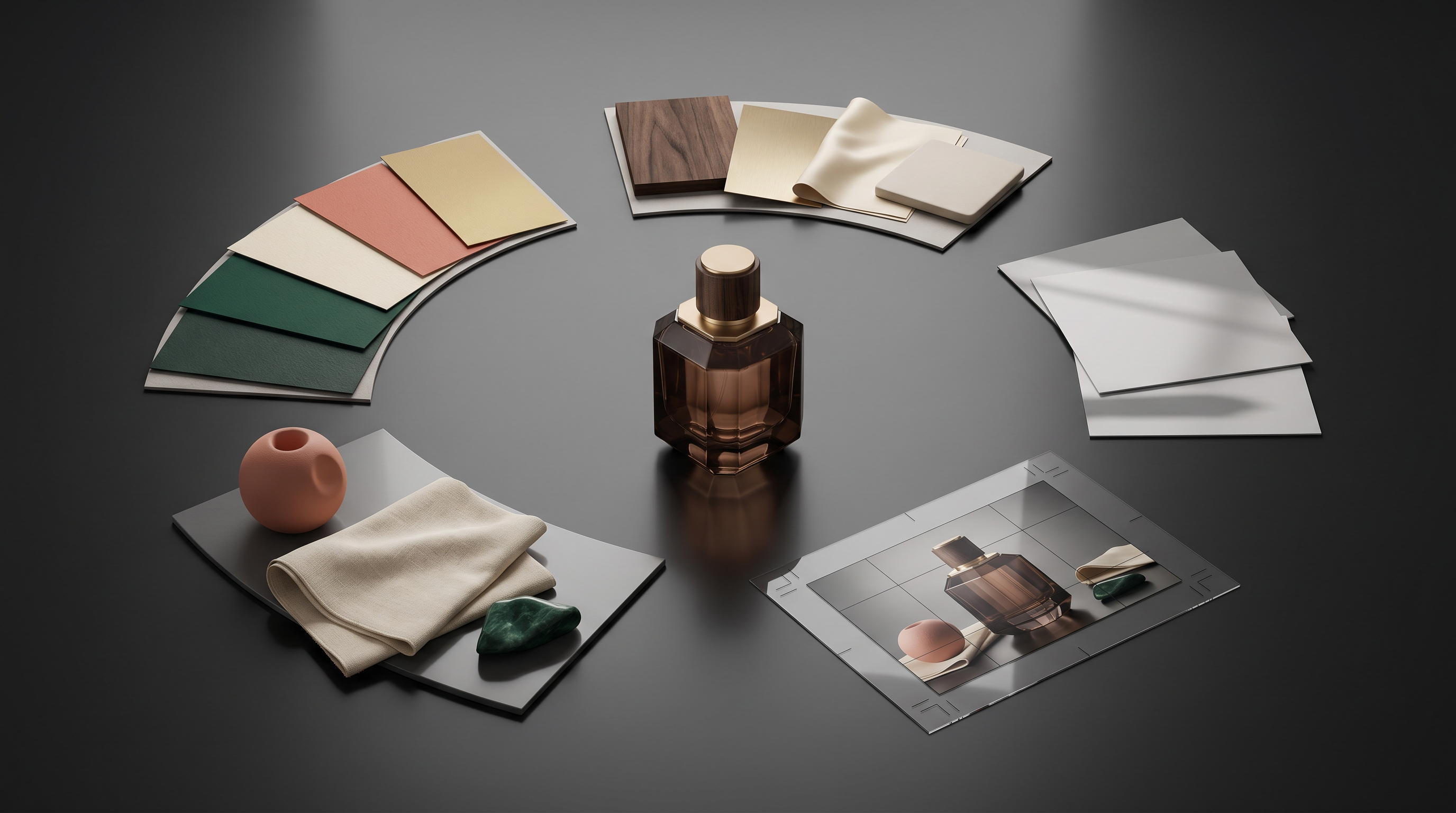
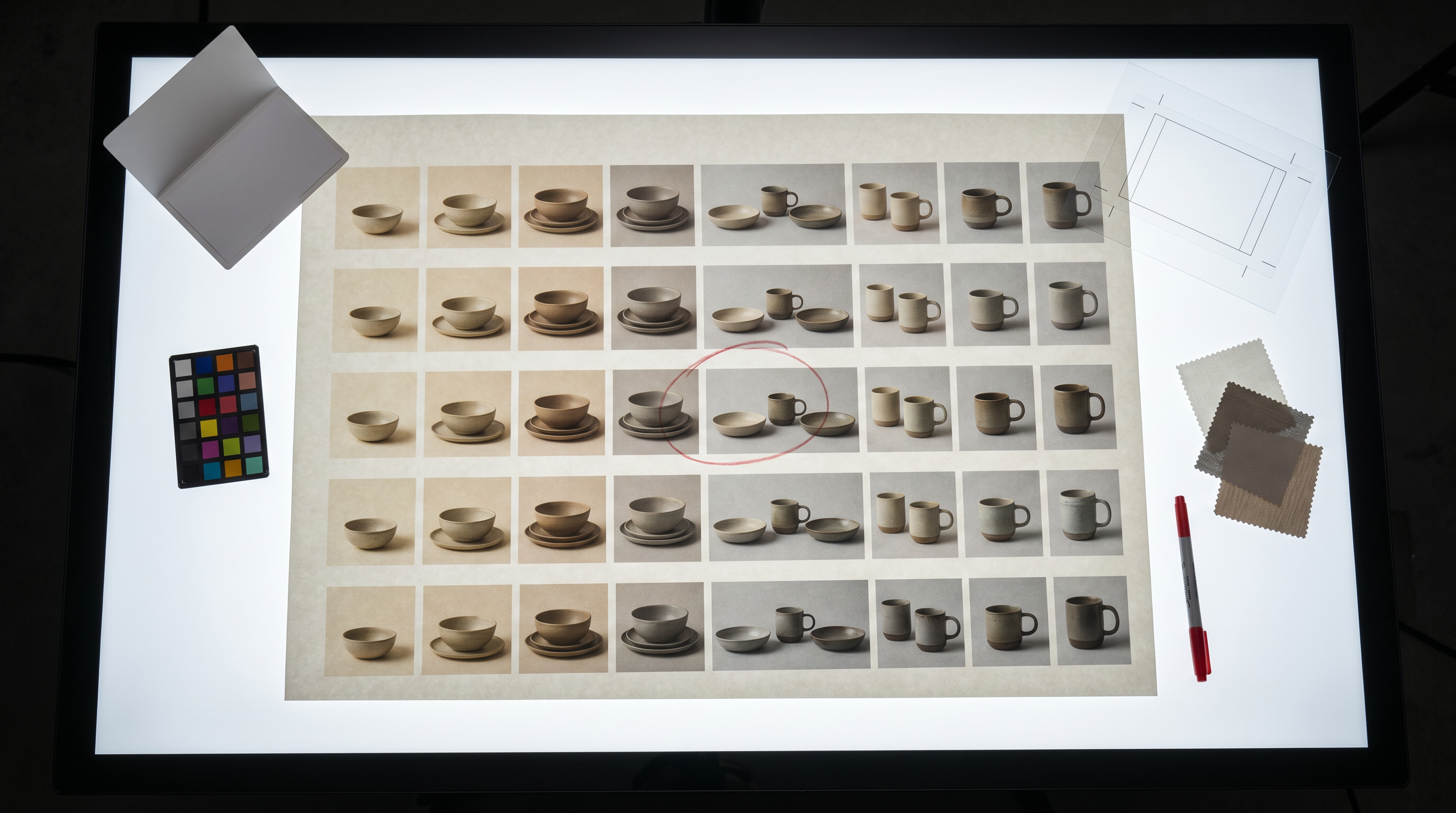
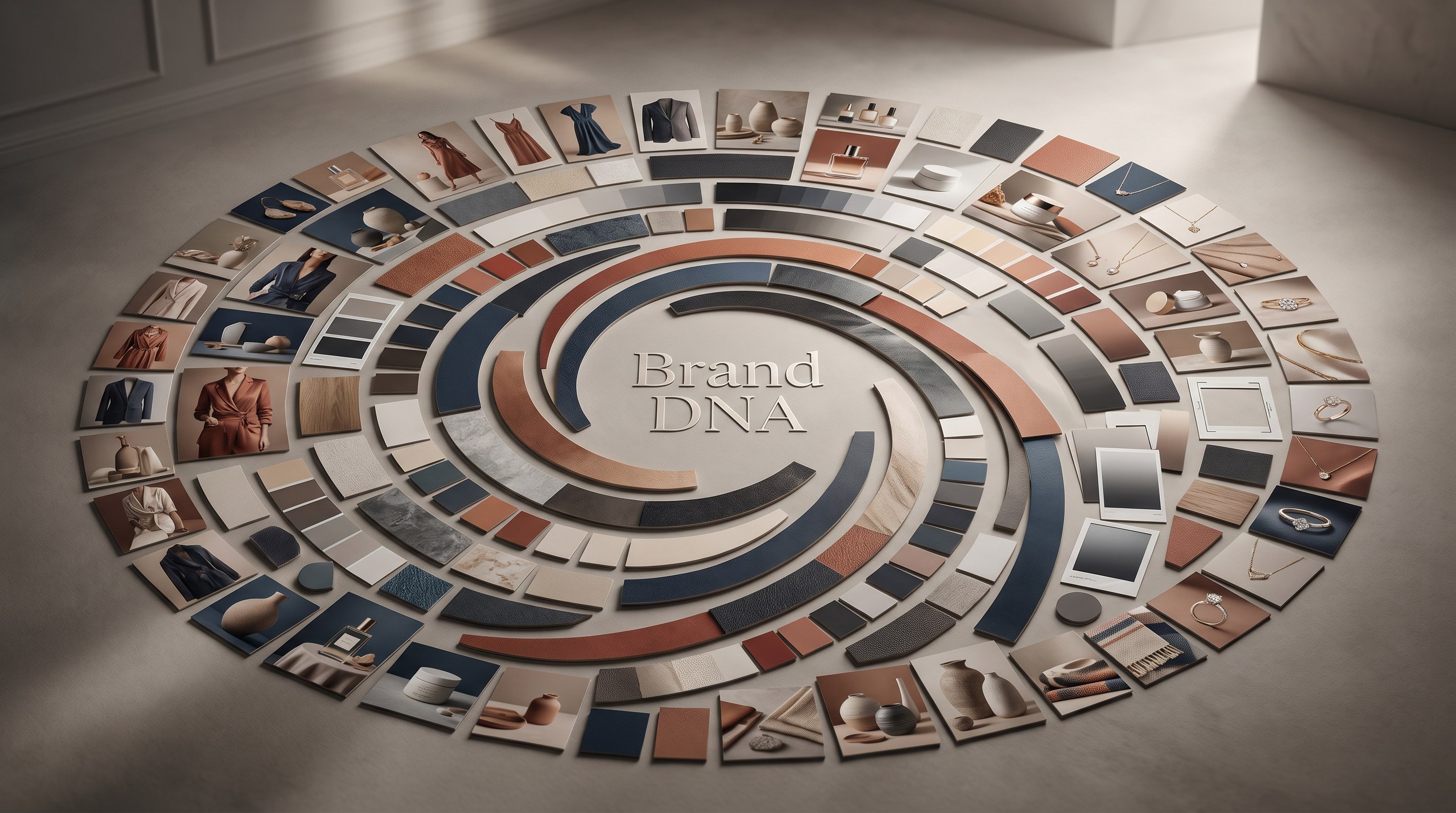
Brand DNA is the layer that closes that gap. Before the model renders a single production image, it is calibrated against the brand's existing hero campaigns — the photography the merchandising team already approved and shipped — so every render fits the brand's existing catalog look. The calibration is small: typically 40 to 120 hero images capture the brand's fingerprint cleanly. The discipline is large: every output is then constrained to that fingerprint, and the catalog stays coherent at scale.
This methodology note explains what Brand DNA learns from the calibration set, how that calibration differs structurally from prompting a generic model, and how to evaluate a Brand DNA AI product photography vendor before committing to a catalog rebuild. It is anchored against the 18-month engagement at a $5B US retailer where the methodology was first proved out, plus the named luxury, furniture, and Amazon programs that have calibrated the model since.

The five brand-fingerprint signals a Brand DNA model has to learn before it renders anything

A calibrated Brand DNA model captures five signals from the hero set. Each signal is the dimension where a generic AI image model drifts off-brand most visibly at catalog scale. The five together are the fingerprint.

1. Palette and color science. The brand's primary, secondary, and accent colors as they appear under the brand's lighting — not as they appear on the swatch. A brand's "navy blue" is rarely #000080; it is whatever specific navy the brand has consistently shipped across two seasons of hero photography. A Brand DNA model captures the actual color the catalog has shipped, not the swatch the brand book claims. Color drift across SKUs — the silent killer of catalog conversion — is the line item where Brand DNA wins most cleanly.

2. Material reproduction. How silk, leather, brushed metal, lacquer, knit, and every other catalog material reads under the brand's lighting. This is the highest-stakes signal for luxury catalogs because the material's "realness" is what reads as luxury. A Brand DNA model that captures the brand's existing silk reproduction can render new silk SKUs that read at parity. A generic model cannot.

3. Lighting character. The directional, soft, hard, warm, or cool character of the brand's hero photography. Editorial fashion catalogs lean directional and contrasty; jewelry catalogs lean diffuse and shadowless; Amazon listings lean flat and high-key. The brand's lighting character is the second-most-stable signal in the hero set and the second-most-likely to drift on a generic model.

4. Composition grammar. Where the product sits in the frame, the negative-space conventions, the cropping cadence, the relationship between product and any contextual element. Brands have grammar even when the brand book has not articulated it. A Brand DNA model that captures the grammar produces composition that the merchandising team recognizes as theirs without needing to articulate why.

5. Product-styling conventions. How the brand styles its products — drape, prop placement, surface staging, on-body posing for apparel and accessories. This is the signal that requires the largest calibration set to capture cleanly because styling vocabulary is brand-specific in ways that other signals are not.

The five signals compound. A Brand DNA model that captures four of five produces catalog imagery that is recognizable but not on-brand. A model that captures all five produces imagery that the brand team approves on the first pass at the 85 to 90 percent rate that lets the production line actually run.

How a $5B US retailer trained the Brand DNA model that now ships ~70% of its catalog imagery

The most useful data we have on Brand DNA methodology is the 18-month production engagement at an anonymized $5B US retailer. The retailer's photography operation before the engagement spanned four photo studios, eleven freelance photographers, two retouching vendors, and a permanent backlog of off-brand drift complaints from the merchandising team. The headline numbers we publish from the engagement — 98% texture accuracy and 60%+ cost reduction — are the bottom line of what Brand DNA calibration produced once it replaced ~70 percent of that operation.

The calibration set for the retailer's Brand DNA model was assembled in the first three weeks. The merchandising team curated 96 hero images from the prior two seasons of campaigns across apparel, accessories, and home — eight images per major category, balanced for color range, material range, and lighting variation. The model trained on that calibration set produced first-pass renders that the merchandising team approved at the 73 percent rate in week one of production.

The next two months were calibration discipline, not new methodology. The 27 percent of week-one renders that failed brand review were categorized by which fingerprint signal had drifted — palette, material, lighting, composition, styling. The signals with the highest drift rate got incremental calibration images added to the training set. By week eight, first-pass approval had risen to 86 percent. By month four, it had stabilized at the 88 to 92 percent range that the production line has held since.

The discipline that mattered most was not the model architecture or the calibration set size. It was the merchandising team's willingness to write down which signal had drifted on every rejection, instead of writing "off-brand" as a single label. The signal-by-signal feedback loop is what turned a 73-percent first-pass model into an 88-percent first-pass model in eight weeks. We covered the cost shape of this engagement line-by-line in our Photography Cost Benchmark Dashboard methodology post earlier this month.

The retailer's catalog now runs ~70 percent of its SKU production through the Brand DNA lane and ~30 percent through hybrid AI-plus-studio production where physical sample photography is still the right call (campaigns, on-body editorial, certain hero shots). The split is the operative state of the engagement at month 18.

What Brand DNA looks like across categories — apparel, jewelry, fragrance, furniture, Amazon

The five fingerprint signals are universal but the weight on each signal varies by category. A Brand DNA model calibrated for apparel will not transfer cleanly to a jewelry catalog without re-weighting the signals. This is the second-most-common mistake brands make when evaluating Brand DNA vendors — assuming a single model serves the full multi-category catalog.

Apparel and accessories. The signals that dominate are palette and composition grammar. Drape and styling are second-tier — important, but the catalog conversion penalty for getting them slightly wrong is smaller than the penalty for color drift across SKUs. The AI photography for fashion brands page is the canonical surface for the apparel application.

Jewelry. The signals that dominate are material reproduction and lighting character. Stones, metals, and surface finishes carry the entire conversion story; palette is fixed by the metal itself. The AI photography for jewelry page is built on this weighting, and Brand DNA's jewelry calibration is the application where the 98% texture accuracy headline number gets tested most aggressively.

Fragrance and beauty. Luxury fragrance is the category where lighting character and styling conventions are the entire story — the bottle is geometrically simple, the brand differentiation is in the editorial treatment around it. Veronique Gabai's luxury fragrance campaign library is the proof anchor here: Brand DNA calibrated against the brand's existing campaign vocabulary, scaled to a full library on the same editorial grammar. A generic AI model cannot reach the bar; a calibrated Brand DNA model can.

Furniture and home. The fifth signal — product-styling conventions, specifically prop placement and surface staging — is the dominant signal. Furniture also benefits structurally from a 3D model source: once a single brand-faithful 3D asset exists, the marginal cost of producing photography, animation, AR, and assembly visuals collapses to nearly zero. The MBM Chairs program shipped 19 videos from a single CAD source on this economics, which we detail on the 3D product animation services page.

Amazon listings. Amazon's image specs, A+ Content requirements, and 3D listing format push the cost shape toward technical compliance rather than editorial refinement. Brand DNA still matters — the brand still needs to look like itself across the 7-image PDP slot — but the dominant signal becomes Amazon-spec compliance (1000px minimums, white-background scoring, 3D viewer compatibility). Crozier Fine Arts and Clutter both calibrated against this Amazon-adjacent technical bar for their respective programs.

The general principle: ask any Brand DNA vendor which two of the five signals dominate in your category. If they answer "all five equally" without weighting, the calibration discipline is not actually category-aware.

How to test a Brand DNA AI product photography vendor in 10 SKUs

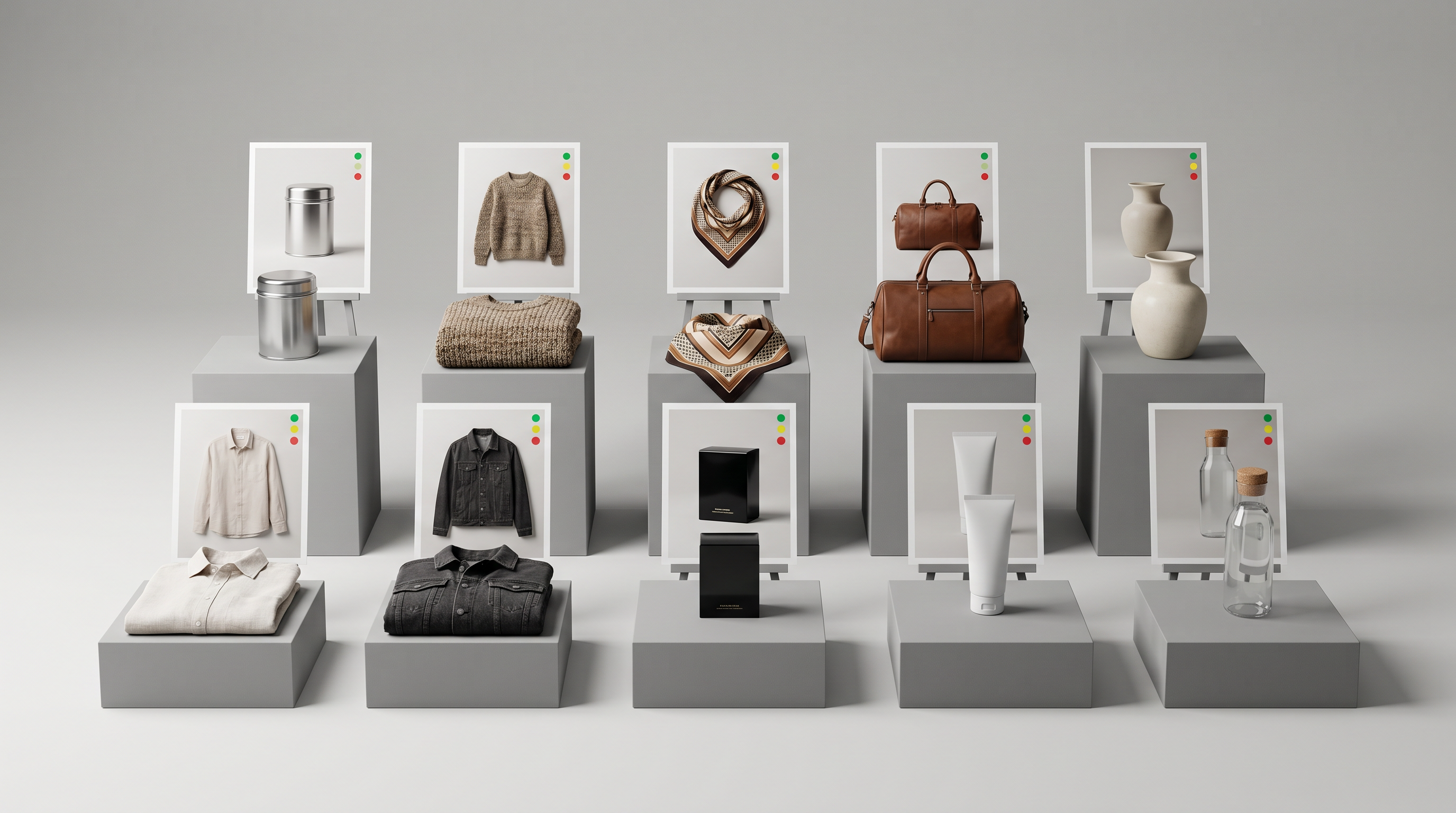
The discipline that matters in evaluating a Brand DNA vendor is to test the methodology, not the demo. A vendor's demo is by definition a curated set of hero shots where the calibration was tightest; the buyer signal that matters is what happens at SKU 11, SKU 50, and SKU 100 when the calibration set is not bespoke to the demo. A 10-SKU pilot is the smallest defensible test that reaches past the demo.

Three pilot disciplines we recommend running, drawn from production engagements:

1. Use the brand's actual existing hero library as the calibration set, not a curated subset. The temptation is to hand the vendor the brand's 12 most-aligned hero images and let the model train on the cleanest signal. That produces a demo, not a test. Hand the vendor the brand's full last-season campaign library — including the images the brand team is least proud of — and let the calibration set reflect the catalog's real signal mix. A Brand DNA methodology that works at production scale should produce a defensible model on that input. One that does not is a demo methodology.

2. Choose 10 SKUs that span the catalog's hardest production cases. Not the easiest. The hero shots, the new launches, the colorways the existing studio struggles with, the materials the existing retoucher has flagged as fragile. The 10-SKU pilot has to put the methodology under load to produce a useful signal. The signal that matters is what first-pass approval rate the model produces on the brand's hardest cases, not on the easiest.

3. Score the failures by fingerprint signal. Whatever fails brand review on the pilot, categorize the failure: palette drift, material drift, lighting drift, composition drift, styling drift. A Brand DNA vendor's signal-by-signal failure pattern after 10 SKUs is the most useful diagnostic of their methodology. A vendor whose failures cluster on one signal has a calibration gap on that signal. A vendor whose failures are diffuse across all five signals has a structural methodology gap and is unlikely to scale past the pilot.

The 10-SKU pilot Advertflair runs at $2,000 with 7-business-day turnaround is structured directly around these three disciplines. The pilot output is a signal-by-signal scorecard alongside the production SKU renders, so the brand team sees exactly which fingerprint signals are at parity and which need a second calibration pass.

External authority context: McKinsey's retail and consumer goods practice remains the canonical reference for how brand consistency at catalog scale affects conversion and lifetime value; the Brand DNA methodology calibrates against their published research on brand-consistency-to-conversion linkage rather than reinventing the framework. Harvard Business Review's marketing research is the secondary authority anchor for how visual consistency compounds into measurable brand equity over multiple seasons.

Run the test. The 10-SKU output will tell you whether the Brand DNA methodology your vendor is offering is calibrated, demo-grade, or somewhere in between. The decision after that is yours.

Frequently asked questions about Brand DNA AI product photography

What is Brand DNA in AI product photography, and why does it matter at catalog scale?

Brand DNA is the layer that calibrates an AI product photography model to a specific brand's catalog before it renders a single image. It captures the five brand-fingerprint signals — palette, material reproduction, lighting character, composition grammar, and product-styling conventions — so every render fits the brand's existing catalog look rather than producing generic AI imagery. At catalog scale, Brand DNA is the difference between an AI vendor that ships 10 hero shots that look great and an AI vendor that can ship 10,000 catalog SKUs that all look like the same brand. The 18-month engagement at a $5B US retailer is what proved the methodology — 98% texture accuracy and 60%+ cost reduction across thousands of SKUs at quality parity with the prior studio operation.

How is Brand DNA different from prompting a generic AI image model?

Prompting a generic AI image model produces an image that matches the prompt's description but does not match the brand. The shadows fall differently. The white balance drifts cool when the brand's hero photography is warm. The drape on the apparel is mathematically plausible but does not match the brand's lookbook drape. At catalog scale, those drift-by-degree differences compound into a catalog that no merchandiser will approve. Brand DNA replaces the prompt with a calibrated model trained on the brand's hero campaigns, color science, and material library — so the first-pass approval rate on shipped batches lands in the 85 to 90 percent range rather than the 20 to 40 percent range typical of prompt-driven workflows.

Can Brand DNA AI product photography really stay brand-faithful for luxury catalogs?

Luxury and brand-faithful AI photography are exactly the categories where Brand DNA earns the trust to displace traditional studios at all. Veronique Gabai's luxury fragrance campaign library and Crozier Fine Arts' Art Basel-tier visuals were both produced on the same Brand DNA engine that powers the $5B-retail engagement. The luxury bar is higher on every brand-fingerprint signal — material reproduction has to read as real silk and real glass, not plausibly synthetic; lighting has to match the brand's editorial character; composition has to respect the brand's negative-space grammar. A Brand DNA model that is calibrated to those signals can clear the luxury bar. A generic AI model cannot.

How long does it take to train a Brand DNA model for our catalog?

The training surface for a Brand DNA model is small — between 40 and 120 hero images from the brand's existing campaign library is typically sufficient to capture the five fingerprint signals. The 10-SKU pilot Advertflair runs at $2,000 with 7-business-day turnaround uses that calibration window directly: the brand provides the hero library, the Brand DNA model trains on the calibration set, the first 10 production SKUs ship in a week. Brands that need a Year-2 narrative — where the brand has evolved and the calibration set has to be refreshed — typically re-calibrate every six to nine months on the same training surface.

What happens to Brand DNA when our brand evolves season to season?

Brand DNA is designed to be re-trained, not frozen. Most enterprise brands evolve their hero look every six to nine months — new campaign palette, new model castings, new editorial direction — and a Brand DNA model that does not evolve with the brand becomes a slow leak of off-brand catalog imagery within two seasons. The discipline that makes Brand DNA work at scale is the re-calibration cadence: a 40-to-120-image calibration refresh every two quarters keeps the model in sync with the brand's current hero campaigns. The cost of re-calibration is roughly one day of internal brand-team review plus a $2,000 to $5,000 re-training run, depending on catalog size.

About the author

Hari Gurusamy is the founder and CEO of Advertflair, the enterprise AI product photography and 3D platform. Hari has spent ten years rebuilding visual content production for retailers — from a 145-person services firm to a 25-person AI platform with named customers including a $5B US retailer (18 months in production at 98% texture accuracy and 60%+ cost reduction), Crozier Fine Arts (Art Basel-tier campaign visuals), Veronique Gabai (luxury fragrance campaign library), the MBM Chairs program (19 videos shipped from a single 3D model source), and Clutter (multi-market hero imagery). The Brand DNA methodology described in this post is the production discipline behind that engagement's results. Connect on LinkedIn.