


A guidance cut is not just a number. It is a signal that every line item is about to get re-read — and creative production is one of the first ones a new or pressured leadership team opens. If you run e-commerce, merchandising, or brand at a retailer that just trimmed its outlook, this quarter you will be asked the same question in five different ways: what can we cut without cutting the things customers actually see?
Here is the pattern we have watched repeat across apparel, footwear, and accessories this season. A brand reports softer comps, trims its full-year guidance, and within two weeks the operating reviews start. Marketing and merchandising get pulled into the same conversation, and product photography lands on the table fast — because it is expensive, it is slow, and it is load-bearing. You cannot ship a PDP, a paid social ad, or a wholesale line sheet without it.
So leaders face what looks like a false choice: keep paying for a traditional studio pipeline they can no longer justify, or slow the catalog down and starve the channels that drive revenue. There is a third option, and it is the one that survives the line-item review. This is how to reduce product photography costs without cutting catalog velocity — and how to prove it in two weeks, not two quarters.
The line item that looks fixed but isn't
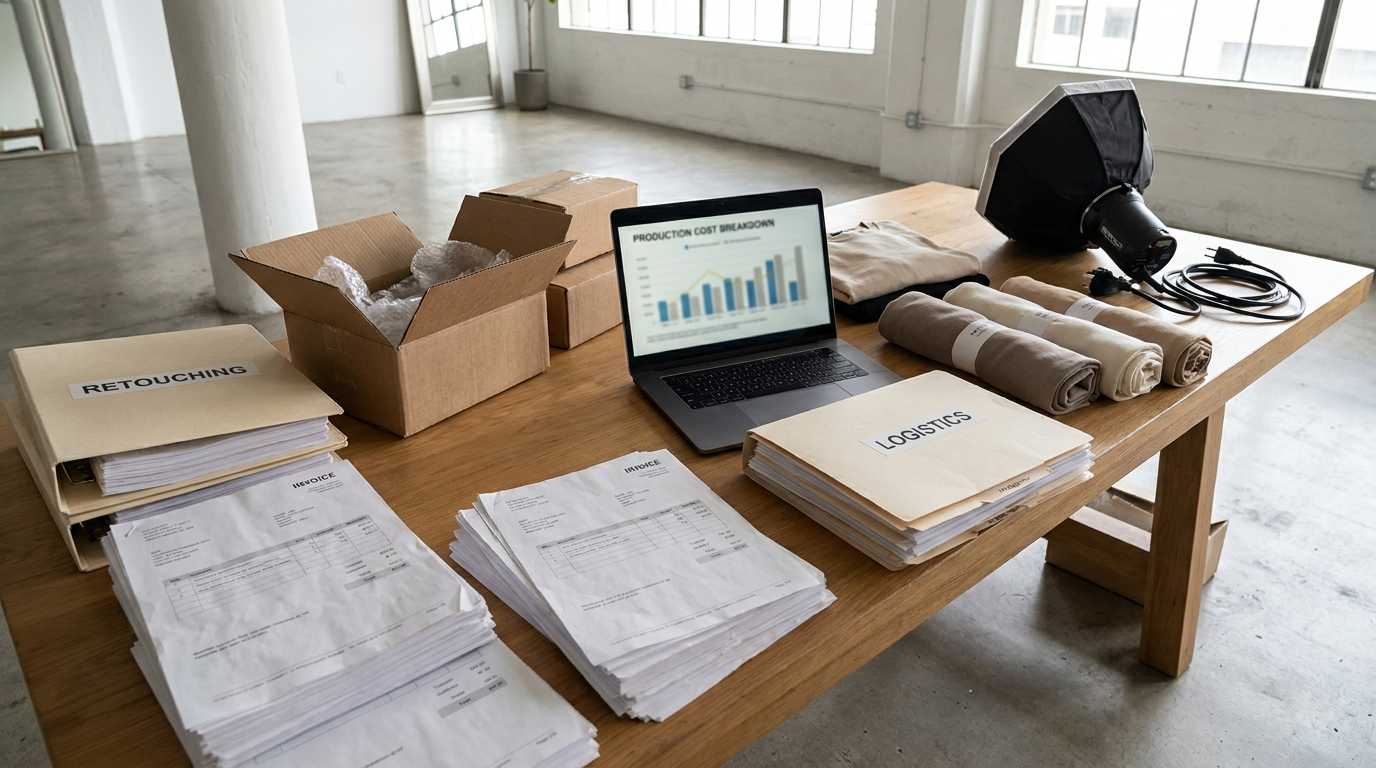
Traditional product photography is priced like a fixed cost — studio day rates, sample logistics, photographer and stylist fees, retouching cycles, reshoots. Most teams treat it as the cost of doing business. But the unit economics are quietly brutal: a mid-market apparel brand routinely spends $40–$80 per finished image once you load in sample shipping, studio time, and post-production, and a single seasonal drop can run into hundreds of SKUs. At enterprise catalog scale, that number compounds into a seven-figure annual line.
AI-generated product photography changes the shape of that cost. Instead of paying per studio day, you pay per output — and the marginal cost of the next 200 images is a fraction of the first. That is the difference between a fixed cost you defend in a budget meeting and a variable cost that scales down when volume drops and up when it spikes, without renegotiating a studio contract. Across 18 months of enterprise production, that shift has delivered a measured 60%+ cost reduction with a 3-day turnaround, which is why this is specifically a guidance-cut-season tool: it cuts the cost of creative production without cutting its velocity.
If you want to put real numbers against your own catalog before you do anything else, our pricing and ROI inputs let you model SKU count against current studio spend in a couple of minutes.
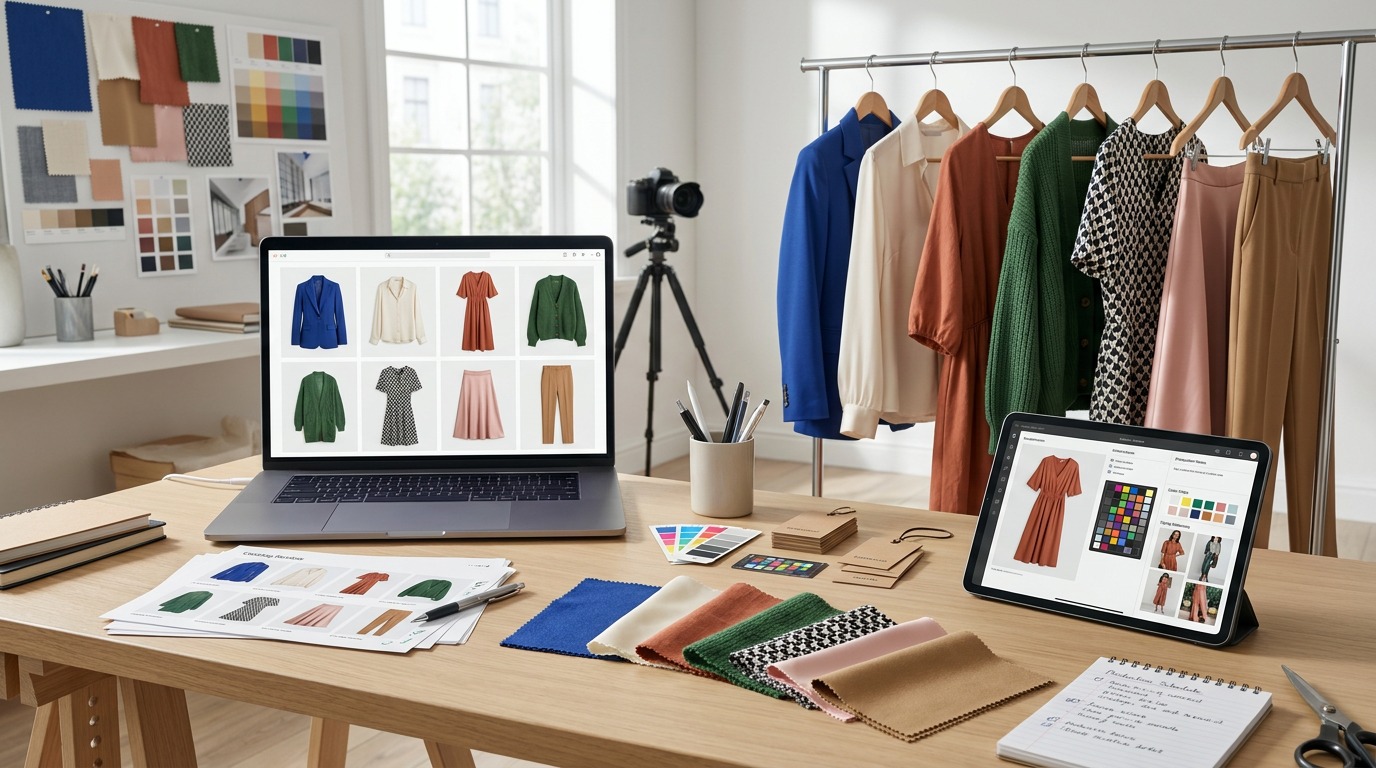
Cutting cost is not the same as cutting quality
The objection we hear from creative leaders is the right one: I can defend a cost cut to the CFO, but I can't defend a catalog that looks worse to the customer. Fair. The bar is not "cheaper images." The bar is images good enough that no shopper, buyer, or brand director can tell the difference — at a fraction of the cost and turnaround.
This matters more than it used to, because product imagery is the single most decisive element on a product page. Baymard Institute's e-commerce UX research has repeatedly found that insufficient or low-quality product images are a leading cause of product-page abandonment. Cutting cost by degrading the asset that converts is not a saving; it is a revenue leak with a delay. The only version of cost-out that holds up is the one where the brand director scrolls the live PDP after the budget meeting and cannot find the seam.
The proof points that matter here are not slogans — they are brands that ship at volume. Advertflair's AI product photography for fashion and apparel runs at 98% texture accuracy benchmarked against traditional studio output, validated in production for a national department-store program at Dillard's. On the luxury end, we built an entire campaign for fragrance house Veronique Gabai — one product shot expanded into ten branded environments at a 75% cost reduction — and we run brand-faithful imagery for a $5B luxury-logistics reference customer whose tolerance for off-brand visuals is effectively zero. When the imagery clears that bar, "cheaper" stops being a tradeoff against "on-brand."
Why Brand DNA is the part that makes this safe to cut toward
The reason generic AI imagery fails a brand review is that it has no memory of your catalog. It produces something that looks like "a jacket," not your jacket, in your lighting, with your fabric behaving the way your fabric behaves. The thing that closes that gap is Brand DNA — a model trained on a brand's existing visual language so output inherits the catalog's color science, material rendering, and styling conventions rather than inventing its own.
That is also what makes AI viable in categories where brand consistency is non-negotiable, from jewelry with photoreal stones and metal finishes to furniture programs like MBM Chairs, where a single 3D model source produced 19 animation videos plus lifestyle renders as one program. The cost comes out; the brand fidelity stays in. For a leadership team being asked to defend a cut, that distinction is the whole argument: you are removing the logistics cost of production, not the quality of the catalog.
What a cost-out move actually looks like
The teams that move fastest in a guidance-cut window do not rebuild their whole pipeline overnight. They run a contained pilot: pick one upcoming drop or one underperforming category; generate the full image set with AI, on-brand, against the existing studio output as the control; put both in front of the people who would reject it — merchandising, brand, the buyers; then compare the all-in cost and turnaround, and decide.
That is a two-week proof, not a two-quarter migration. And it gives a pressured leadership team exactly what they need for the next operating review: a real number, a real comparison, and a decision they can defend. This month one media-services customer ran exactly that motion and moved from pilot to paid in a single cycle — a small, concrete data point that the model works in practice, not just on a slide. (For the record, two customers paid Advertflair this month, so the "does anyone actually buy this" question already has a yes behind it.)
If you want the fuller menu of what a vertical-specific engagement covers before you scope a pilot, the AI Solutions by industry hub breaks it down by category.
Why now, specifically
Three things are converging. First, retail guidance cuts are clustering this season, so the cost-out conversations are already happening — you are not introducing the topic, you are arriving with a better answer to one that is already on the table. McKinsey's retail research has been flagging margin pressure and the shift toward operating-efficiency moves across the sector for several cycles running.
Second, new leadership is rotating into CMO, CCO, and creative-director seats across the category, and a new leader's first 90 days are when line items get re-read most aggressively. Third, the quality bar for AI product imagery has finally crossed the threshold where it survives a brand director's scroll — which is a recent development, not a long-standing one.
If you are heading into a budget review with creative production on the chopping block, the move is not to defend the old number. It is to bring a better one — and to bring it with proof a brand director already signed off on.
The lowest-risk way to start
You do not have to bet the catalog to find out whether this works for you. A single-category or single-drop pilot, with your existing studio output as the control, caps the downside at two weeks of effort and produces a comparison real enough to take into the next operating review. If the imagery clears your brand bar at a lower all-in cost, you scale. If it does not, you have spent two weeks and learned something concrete. Either way, you walk into the review with data instead of a defense.
Start a $2,000 apparel / fashion AI photography pilot → pay now (10 SKUs, delivered in 7 business days). Prefer to talk first? Book a 15-minute cost-out walkthrough → Or model the savings at advertflair.ai/pricing.

Frequently asked questions
How much can AI product photography actually save versus a traditional studio?
Most mid-market brands spend $40–$80 per finished image once sample logistics, studio time, and retouching are loaded in. AI-generated photography shifts that to a per-output cost where the marginal cost of additional images drops sharply, so total savings scale with catalog size. Across 18 months of enterprise production, Advertflair has delivered a 60%+ cost reduction at a 3-day turnaround.
Will the images be good enough for our PDPs and brand standards?
The bar is images indistinguishable from studio output to shoppers, buyers, and brand directors. Advertflair benchmarks at 98% texture accuracy versus traditional studio output, validated in production at Dillard's and on luxury campaigns for Veronique Gabai. The way to verify for your own catalog is a side-by-side pilot reviewed by the same people who would normally reject off-brand imagery.
How fast can we run a pilot during a cost-out window?
A contained pilot on one drop or one category is a roughly two-week proof, not a multi-quarter migration. The standard $2,000 pilot covers 10 SKUs delivered in 7 business days, giving you an all-in cost comparison and turnaround number you can take straight into the next operating review.
Does this replace our creative team?
No. It removes the fixed studio-pipeline cost — sample shipping, day rates, reshoot cycles — so the creative team spends its time on direction and brand, not logistics. It cuts the cost of production, not the velocity of the catalog. Brand DNA technology keeps the output on-brand so the team is editing, not rebuilding.
What is the lowest-risk way to start?
A single-category or single-drop pilot with your existing studio output as the control. If the imagery clears your brand bar at a lower all-in cost, you scale; if it does not, you have spent two weeks and learned something. The downside is capped and the comparison is real.
About the author: Hari Gurusamy is the Founder & CEO of Advertflair, the enterprise AI product photography and 3D platform behind 18 months of production imagery at Dillard's, plus Veronique Gabai, MBM Chairs, and Clutter. Aerospace engineer by training, MBA, Brooklyn-based — building the pipeline that lets retail content teams cut production cost without cutting catalog velocity.

