

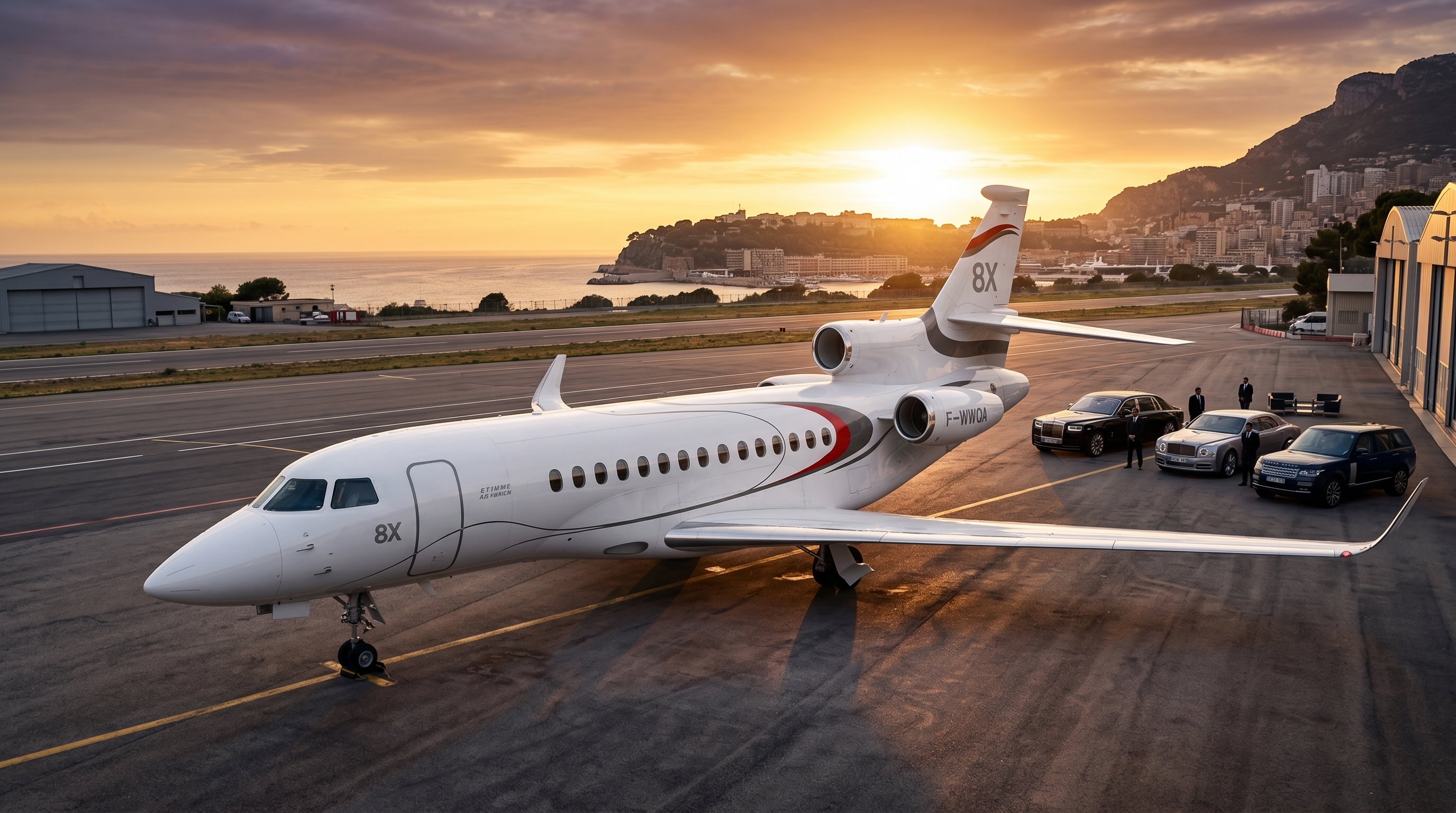
In private aviation, the deliverable that closes a fractional share sale isn't the spec sheet. It's the moment the buyer sees their cabin — their leather palette, their family's configuration, their galley layout — and stops comparing operators.
This is the story of how one fractional operator delivered that moment inside a 14-day decision window, without ever opening a hangar, and signed a $3.4M one-eighth share of an ultra-long-range trijet. The full case study, with the complete render library, is live here: $3.4M Trijet 1/8 Share Sale — Ultra-Long-Range Cabin Renders.
The setup: a 14-day window and an aircraft on three continents
A UHNI family was in active comparison with two competing fractional operators, evaluating a 1/8 share of a 6,450 nm trijet — 16 passengers, 42.7 ft cabin, the quietest in business aviation at 49 EPNdB. The family gave all three operators the same two-week decision window.
The operator's problem was physics, not marketing. The actual aircraft was in active fractional rotation across three continents. The traditional answer — reposition it to a studio hangar, dress the interior, fly in a photo crew — carried a minimum six-week lead time and a cost north of $150K, plus ten days of lost revenue service. Six weeks does not fit inside fourteen days. Stock cabin photography of a different airframe in a different configuration wasn't going to close a family that had asked, specifically, to see:
• their winter leather palette on the seating,
• the Privacy Suite set up as a children's rest area,
• a kosher-certified galley layout, and
• the three-lounge family configuration during cruise.
The approach: CAD in, photoreal render library out
The operator supplied two things: the CAD interior model of the trijet, and the four prospect-supplied interior schemes — leather, veneer, lighting profile, lounge configuration. No hangar shoot, no aircraft repositioning, no crew dispatched. From those inputs alone, our render team built the complete cabin package on a 14-day clock:
Days 1–3 — CAD interpretation + base scene build. Cabin geometry extracted from the CAD model; base scene built with correct monument positions, lavatory and crew rest layouts, and galley equipment placement.
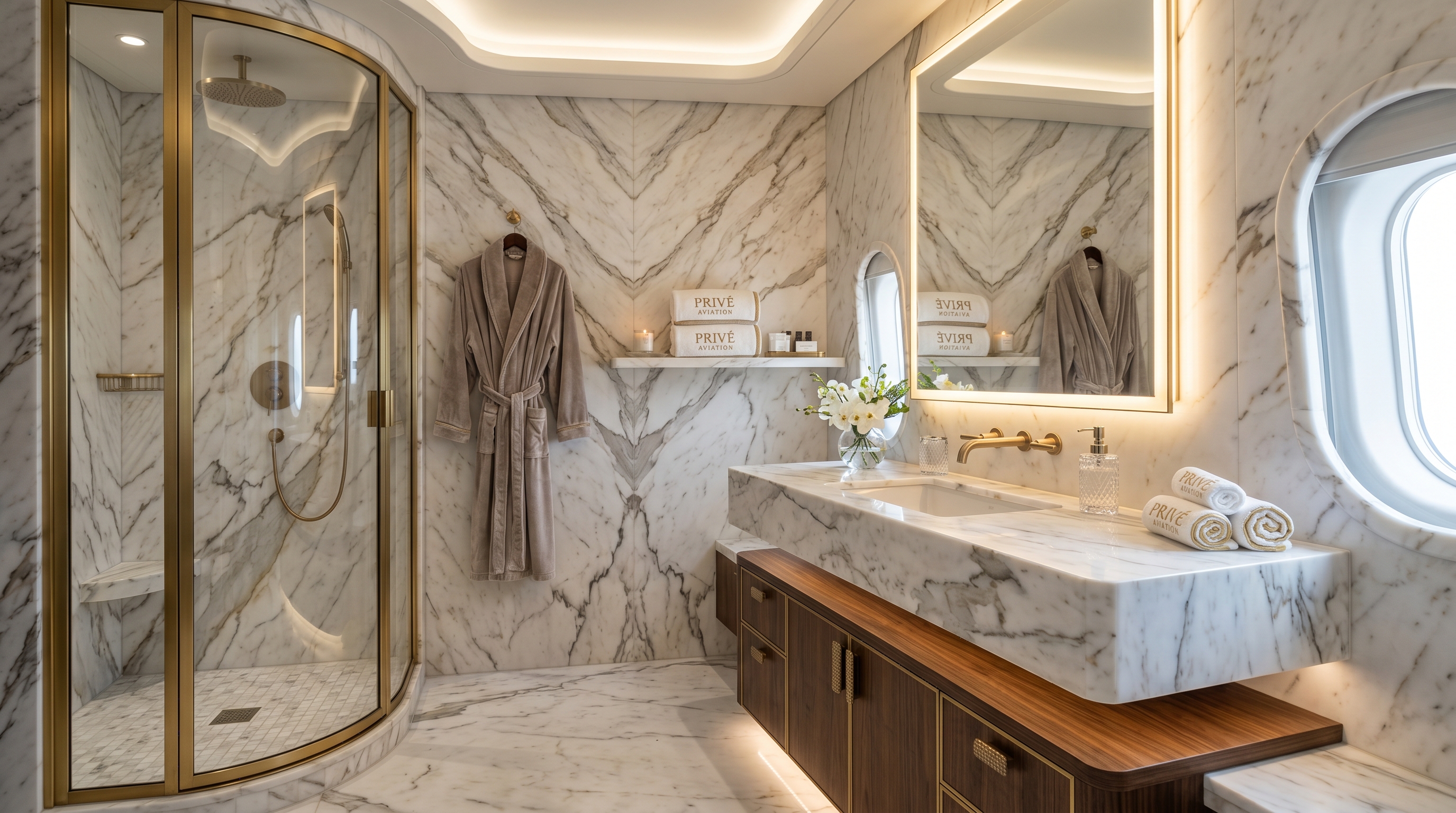
Days 4–9 — Material + lighting library. The family's leather, veneer, carpet, polished metal, and soft furnishings, built as a reusable material library — plus six master lighting setups covering cruise (day), cruise (night), takeoff, and descent.
Days 10–14 — Output render package. Main cabin heroes, lounge and galley compositions, and macro close-ups for the materials review — each delivered in high-resolution print and web variants, ready for the pitch deck.
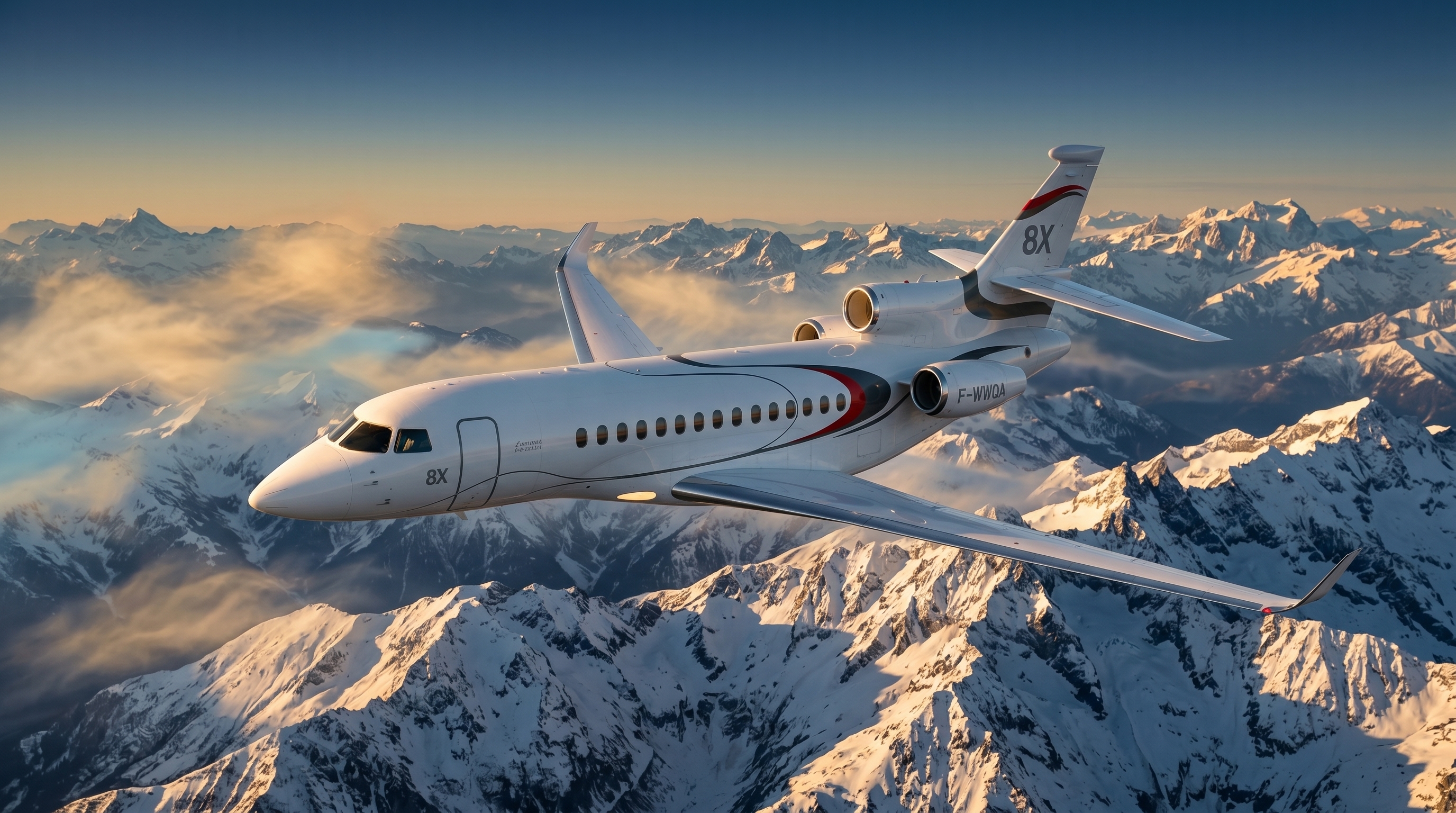
Why personalization is the whole game in fractional sales
A $3.4M share decision is not a rational spreadsheet exercise — it's a family picturing themselves at 51,000 ft. The render library let the operator put the family inside their own aircraft before it existed in that configuration: the Privacy Suite as a children's rest area, their materials under the actual cabin lighting logic, their galley spec.
That's the structural advantage of CAD-to-photoreal over photography in this segment. A photo shoot captures one configuration, once. A render library is parametric — the same base scene re-renders in every prospect's preferred materials and layout, for every future pitch. The operator now uses the same library for share-marketing decks and charter pitches, re-dressed per prospect.
The numbers
14 days from CAD input to delivered render package — against a six-week minimum for a hangar shoot. $150K+ avoided in repositioning, hangar, crew, and styling costs — plus ten days of revenue service the aircraft never lost. And the outcome that matters: the family signed the $3.4M share inside the window.
This is the same CAD-to-photoreal pipeline behind our 74m Amels superyacht render library for Fraser Yachts — a €89.9M brokerage listing rendered to brokerage-grade in 14 days — and the collector-preview workflow we run for Crozier Fine Arts, courier of record for the major auction houses. Different verticals, same economics: when the asset can't come to the camera, the render library replaces the shoot.
What this means if you sell high-ticket physical assets
The pattern generalizes well beyond aviation. If your sales cycle involves a physical asset that is expensive to stage — aircraft, yachts, fine art, luxury goods, even deep-catalog retail — the question to ask is the one this operator asked: what does it cost us every time the asset has to be physically present to be sold?
For product categories at retail scale, the same pipeline drives our AI solutions hub — with vertical-trained workflows for fashion and apparel and jewelry and luxury, where 98% texture accuracy and 3-day turnarounds are the production standard from 18 months at $5B retail scale.
Bring your CAD. Get your render library.
The entry point is deliberately simple: 10 photoreal renders from your CAD or reference material, delivered in 7 business days, with full credit toward production if you scale to a campaign. Start a $2K pilot now → or book a quick consultation if you'd rather walk through your asset first. The full case study with the complete output gallery is at casestudies.advertflair.com/private-jet-share-sale.
About the author: Hari Gurusamy is the CEO of Advertflair, the enterprise AI product photography and 3D platform behind 18 months of production imagery at Dillard's, plus Crozier Fine Arts, Fraser Yachts, Torani, Veronique Gabai, and MBM Chairs. Aerospace engineer by training, Brooklyn-based — which makes the aviation render briefs the fun ones.

