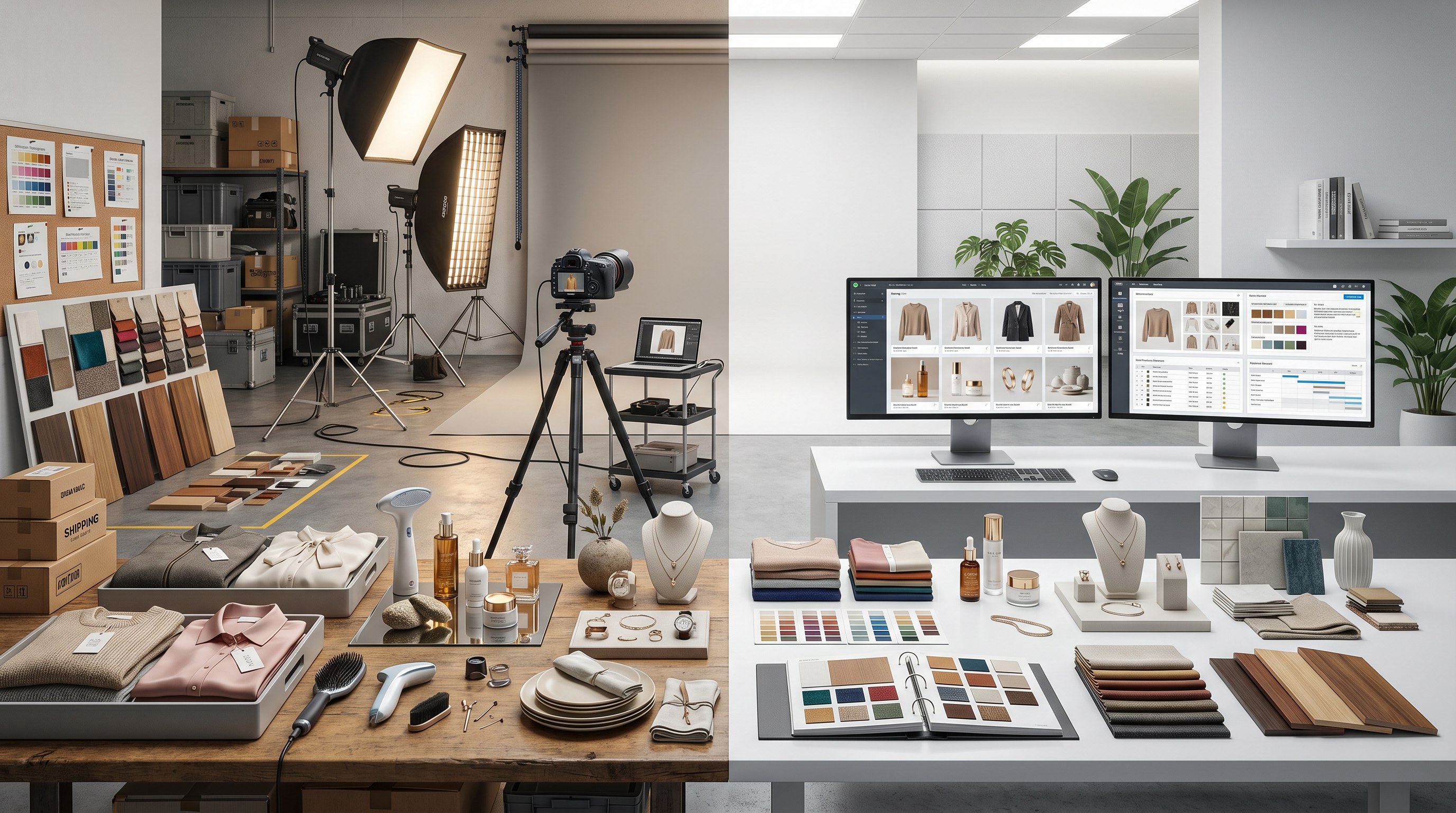

Quick context: Advertflair is the enterprise AI product photography and 3D platform behind 18 months of production at a $5B US retailer, the MBM Chairs 19-video animation program, Crozier Fine Arts' Art Basel-tier visuals, and Clutter's multi-market hero imagery. This piece is about a cost most brands underestimate until it lands on the budget: re-photographing the entire catalog when you rebrand. Model your catalog's re-shoot cost in 60 seconds →
The hidden line item in every rebrand: re-photographing 200+ SKUs
A rebrand is rarely just a logo. For a product company, a brand refresh — new color system, new packaging, new visual standard — sets off a chain reaction that ends at the one place nobody budgets for early enough: the catalog. Every product image on your site, your retail partners' PDPs, your Amazon listings, your wholesale line sheets, and your marketplace tiles now looks like the old brand. And there can be hundreds, or thousands, of them.
2026 has been a heavy year for rebrands in exactly the categories where catalogs are largest. Food and beverage brands are rolling out full packaging redesigns across 150 to 250 SKUs. Furniture and home goods brands are relaunching catalogs around new seasonal lines and showroom standards. In each case the strategic work — the new identity — is the easy part to approve. The operational tail is the expensive part: somebody has to make every existing product photograph match the new standard, and most teams discover the size of that bill only after the creative is signed off.
This is the product photography for a catalog rebrand problem, and it is structurally different from a normal catalog shoot. A normal shoot adds new SKUs over time. A rebrand re-shoot requires the entire existing catalog to change to a new standard at once — and to stay perfectly consistent across every one of those hundreds of SKUs. That "all at once, perfectly consistent" requirement is what makes the traditional version of this job so slow and so costly.

What re-photographing a catalog actually costs in a traditional studio
Start with the per-SKU rate, then add the parts of the bill that a rebrand specifically inflates. Across the high-SKU verticals most affected by 2026's rebrand wave, traditional studio per-SKU catalog rates cluster like this: furniture around $148, home goods around $82, food and beverage around $74 to $90 depending on whether packaging needs macro detail. A 200-SKU re-shoot at a blended ~$110 per SKU is roughly $22,000 before anything goes wrong — and on a rebrand, things go wrong more than usual.
Three line items inflate specifically on a rebrand re-shoot:
Restyling and re-staging. Every product has to be physically pulled, re-staged to the new visual standard, lit to the new lighting recipe, and shot again. For furniture and large home goods, that means warehousing, moving, and setting heavy product — the single most expensive logistics line in a catalog shoot. None of it is reusable from the original shoot.
Brand-consistency QA, billed per image. The honest cost of making 200 SKUs all look like the same new catalog is QA: a senior retoucher, a brand-standards reviewer, and a second or third pass on every image to confirm the new color, the new background, and the new framing are identical across the set. Traditional studios price this as a per-image surcharge — frequently a 15 percent uplift on catalog work — and on a rebrand, where consistency is the deliverable, it is unavoidable.
Reshoots. Survey data across catalog work puts traditional studios at roughly 1.8 reshoots per SKU, each billed. On a rebrand, where the standard is brand-new and being interpreted for the first time, the early batches almost always miss and get re-billed. The all-in number routinely runs 60 to 80 percent over the headline per-SKU rate once reshoots and brand-QA are counted — so that "$22,000" 200-SKU job is realistically a $35,000 to $40,000, one-quarter-long project. McKinsey's retail and consumer goods research has long documented how creative-services costs like these hide in custom-quote pricing, where opacity benefits the incumbent vendor.
What would your rebrand re-shoot cost? →
Drop in your SKU count and current per-SKU rate. Get the all-in re-shoot number, the AI-native alternative, and a CFO-ready PDF.
The AI-native alternative: re-render the catalog, don't re-shoot it
The structural insight behind AI product photography for furniture brands, food and beverage companies, and home goods catalogs is simple: if a product can be represented once — as a 3D model, or reconstructed from existing photography and CAD — then changing its look no longer requires touching the physical product again. You change the rendering standard, not the studio set.
Here is how an AI-native rebrand re-shoot runs in practice. First, Advertflair builds a customer-specific Brand DNA model on the new brand standard: the exact color values, the new lighting recipe, the new framing and background, the material and surface finishes the rebrand specifies. This is the one-time investment, and it is where the brand judgment lives. Then every SKU in the catalog renders through that single model. Because every image comes from the same model, brand consistency is not a per-image QA surcharge — it is structural. The second photo matches the first because they were generated by the same brand standard, not corrected into agreement afterward.
The economics invert the traditional bill. AI-native per-SKU rates across these verticals run $28 to $48 at the same brand-consistency bar, reshoots collapse from 1.8 per SKU to roughly 0.2, and the brand-QA surcharge disappears because consistency is built into the model. First-pass approval runs 88 to 92 percent. The all-in result, validated across an 18-month engagement at a $5B US retailer, is a 60 percent-plus cost reduction at 98 percent texture accuracy against the retailer's own studio output — with the catalog re-rendered in 3 to 4 days rather than rolled out over a quarter. For a fuller picture of the unit economics behind these numbers, the high-SKU catalog photography guide walks through how per-SKU rates behave as catalog size grows.
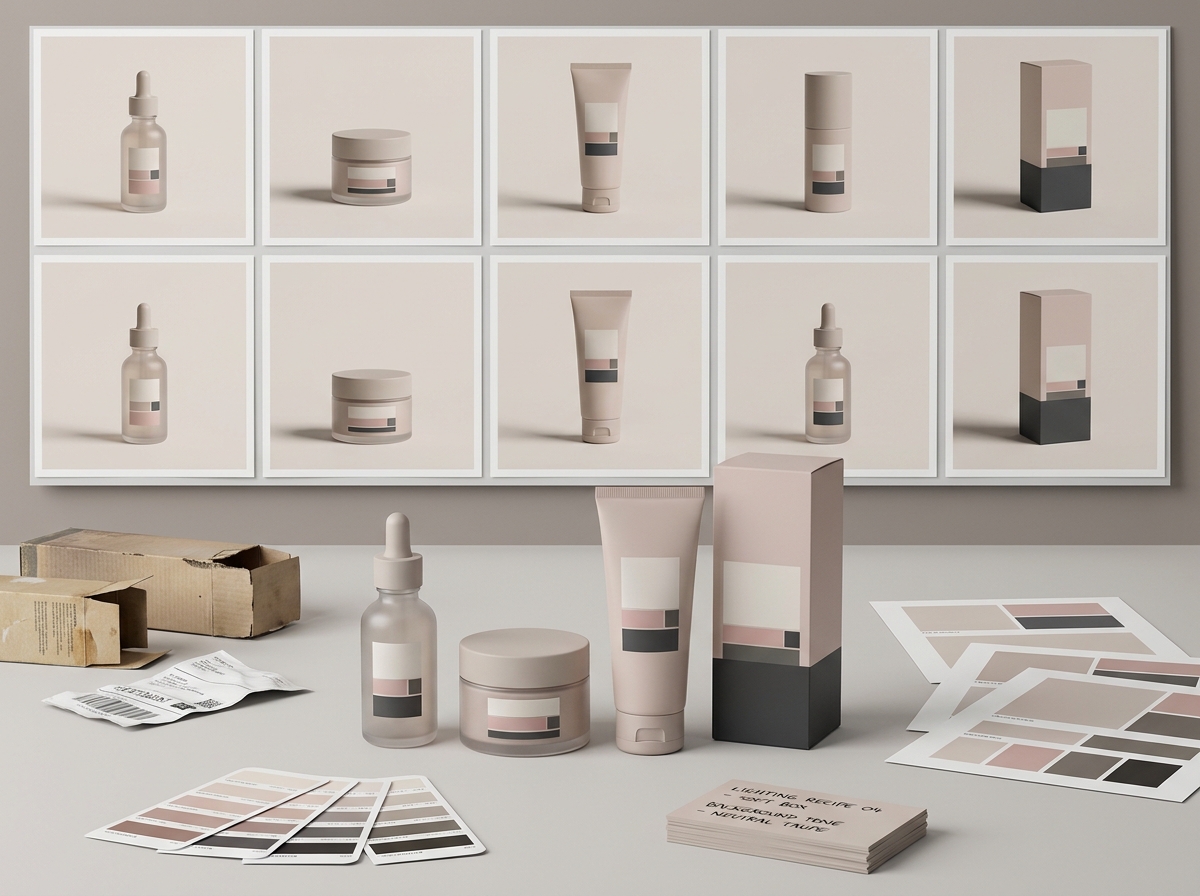
Furniture and home goods: relaunch the catalog from one 3D source
Furniture is the clearest case for re-rendering over re-shooting, because furniture is the most expensive product to physically re-stage and the easiest to represent once in 3D. A chair, a clock, a cabinet, a lighting fixture — model it once, and every catalog refresh after that is a rendering job, not a warehouse-and-shoot job.
The MBM Chairs program is the proof point we point to most often: from a single CAD source, the engagement produced 19 videos plus a full still-render library, all brand-faithful, all reusable. When a furniture brand built that way decides to relaunch its catalog around a new seasonal standard, it does not re-stage a warehouse — it re-renders the existing 3D catalog against a new Brand DNA model and ships the whole thing in days. The relaunch cost per SKU approaches the marginal cost of a render, not the fully loaded cost of a studio day. That is the difference between a rebrand being a budget event and a rebrand being a routine catalog operation. The AI Solutions hub details how the same Brand DNA engine spans catalog photography, 3D configurators, and animation from one model source.
Food and beverage: when packaging is the brand, accuracy is non-negotiable
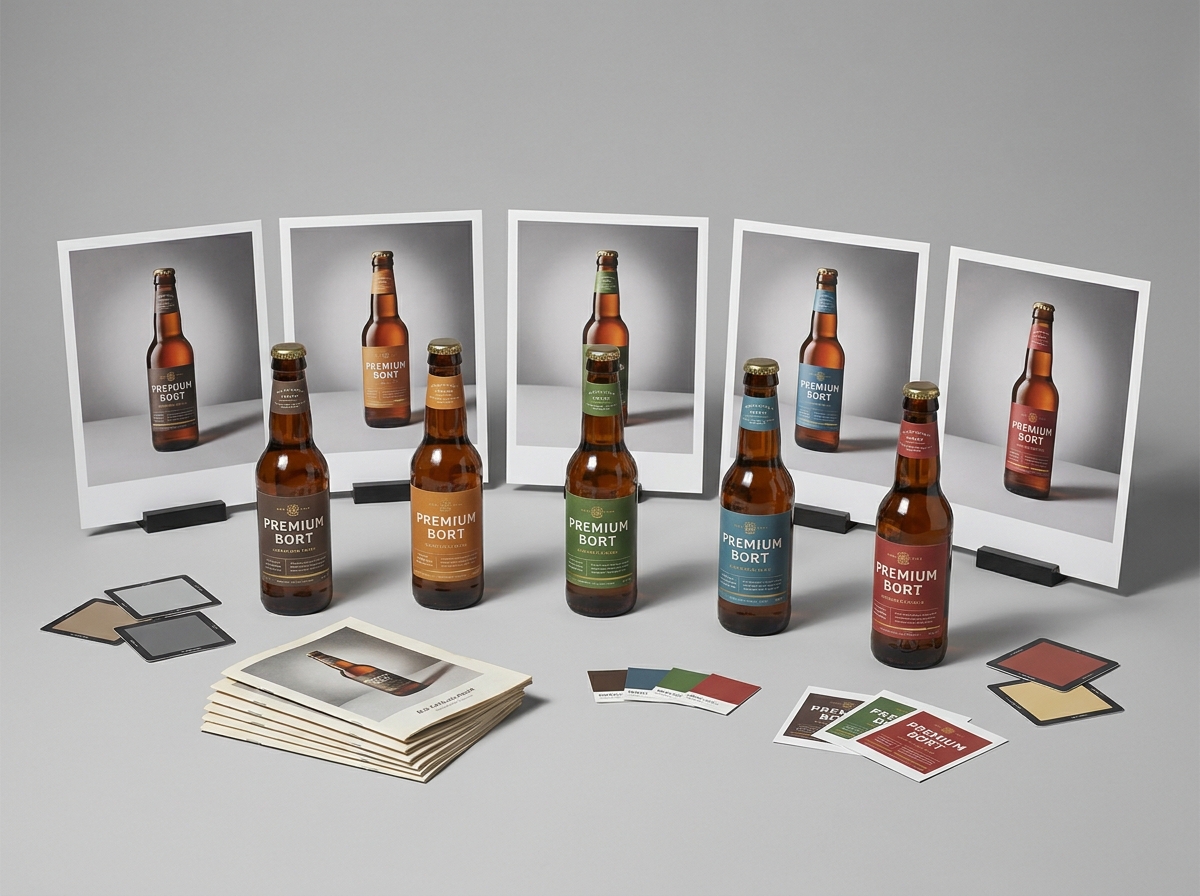
Food and beverage rebrands are different in one important way: the packaging is the product image. A new label system, a new color palette, a new substrate finish — the rebrand lives on the bottle, the bag, the box. So food and beverage packaging photography for a rebrand is fundamentally a brand-accuracy problem at scale: every SKU's new packaging has to render at exact brand color, exact label placement, and exact material finish, across a 150 to 250 SKU line, with no drift.
This is precisely where the per-image-QA cost of traditional studios is worst and where a single-model AI pipeline is strongest. Because the Brand DNA model encodes the new packaging standard once, every SKU inherits the same color values and finish behavior. Torani, our food and beverage reference, anchors how the engine holds packaging fidelity across a flavor-dense catalog. And the accuracy bar is not theoretical: the same pipeline held 98 percent texture accuracy against physical reference across the 18-month $5B-retailer engagement — the kind of fidelity packaging rebrands require before they will trust a render over a photograph. Harvard Business Review's operations-management research frames exactly this kind of consistency-at-scale problem as where process design, not extra labor, produces the durable cost advantage.
How to budget a rebrand re-shoot without overpaying
Three concrete moves, in order of how much they protect your budget this year:
1. Price the re-shoot before you approve the rebrand. The catalog re-photography cost should be a line in the rebrand business case from day one, not a surprise after sign-off. Use the catalog size and your current per-SKU rate to model the all-in number — including reshoots and brand-QA, not just the headline rate. The cost benchmark and calculator produces that number, and the AI-native comparison, in about a minute.
2. Inventory what already exists as 3D. Any SKU that exists as a 3D model — or that was ever modeled for a configurator, an animation, or an Amazon 3D listing — can be re-rendered for the rebrand at near-zero marginal cost. Brands that have built a 3D catalog discover their rebrand re-shoot is already 60 to 80 percent done. If you do not have a 3D catalog yet, a rebrand is the highest-ROI moment to build one, because the cost is amortized across this re-shoot and every future one.
3. Run a Brand DNA pilot on the new standard first. Before committing the whole catalog, validate the new brand standard on a small set of representative SKUs — the hardest material, the trickiest packaging, the hero product. A brand-consistent product photography at scale program lives or dies on whether the model nails the new standard, so prove it on the hard cases first, then scale to the full catalog with confidence. For named-customer detail on how this ran in production, the 18-month $5B US retailer case study documents the per-SKU rate, the reshoot rate, and the all-in 60 percent-plus cost reduction across thousands of SKUs.
Re-render your catalog instead of re-shooting it →
Start a 5-SKU AI pilot on your new brand standard. Prove the match on your hardest products before you scale.
Or talk it through first →
A 15-minute walkthrough of what your rebrand re-shoot would cost AI-native, against your current catalog and timeline.
Frequently asked questions
What does it cost to re-photograph a product catalog for a rebrand in 2026? Traditional studios price a re-shoot per SKU plus restyling and brand-QA — roughly $82 to $148 per SKU across furniture, food and beverage, and home goods, so a 200-SKU re-shoot lands at $20,000 to $40,000 all-in over a quarter. AI-native production runs $28 to $48 per SKU, re-renders the catalog in 3 to 4 days, and delivers a 60 percent-plus all-in cost reduction.
Why is a rebrand re-shoot more expensive than a normal catalog shoot? Because it is a consistency problem, not a volume problem. The entire catalog has to change to a new standard at once and stay identical across hundreds of SKUs. Traditional studios bill that consistency as restyling plus per-image brand-QA; an AI-native pipeline makes it structural by rendering every SKU through one Brand DNA model.
Can AI re-photograph an existing catalog without re-shooting every product? Yes, when products exist as 3D models or can be reconstructed from existing photography and CAD. The catalog is re-rendered against a new Brand DNA model — updating lighting, color, framing, and background with no physical re-staging. The MBM Chairs furniture program, which produced 19 videos and a full render library from one CAD source, is the model case.
How long does an AI catalog rebrand re-shoot take versus a traditional studio? Traditional studios roll a rebrand out in 14-to-21-day batches over a quarter or more. AI-native delivers a re-rendered catalog in 3 to 4 days once the Brand DNA model is approved, at 98 percent texture accuracy against studio reference — proven across an 18-month $5B-retailer engagement.
Does AI keep packaging and materials brand-accurate for a rebrand? Yes — accuracy is the entire point. The Brand DNA model is trained on the new brand standard (exact color, finish, label placement) and every SKU renders through it, holding 98 percent texture accuracy against physical reference, the bar food and beverage packaging rebrands require.
Hari Gurusamy
Founder & CEO, Advertflair (DBA Vela Studio, Glam AI, Style AI)
Hari founded Advertflair in 2016 and led the pivot from a 145-person 3D services firm to a 25-person enterprise AI product photography platform. The Brand DNA engine he and the team built has run in production at a $5B US retailer for 18 months, on the MBM Chairs 19-video animation program, on Crozier Fine Arts' Art Basel-tier visuals, and on Clutter's multi-market hero imagery. Connect with Hari on LinkedIn.