

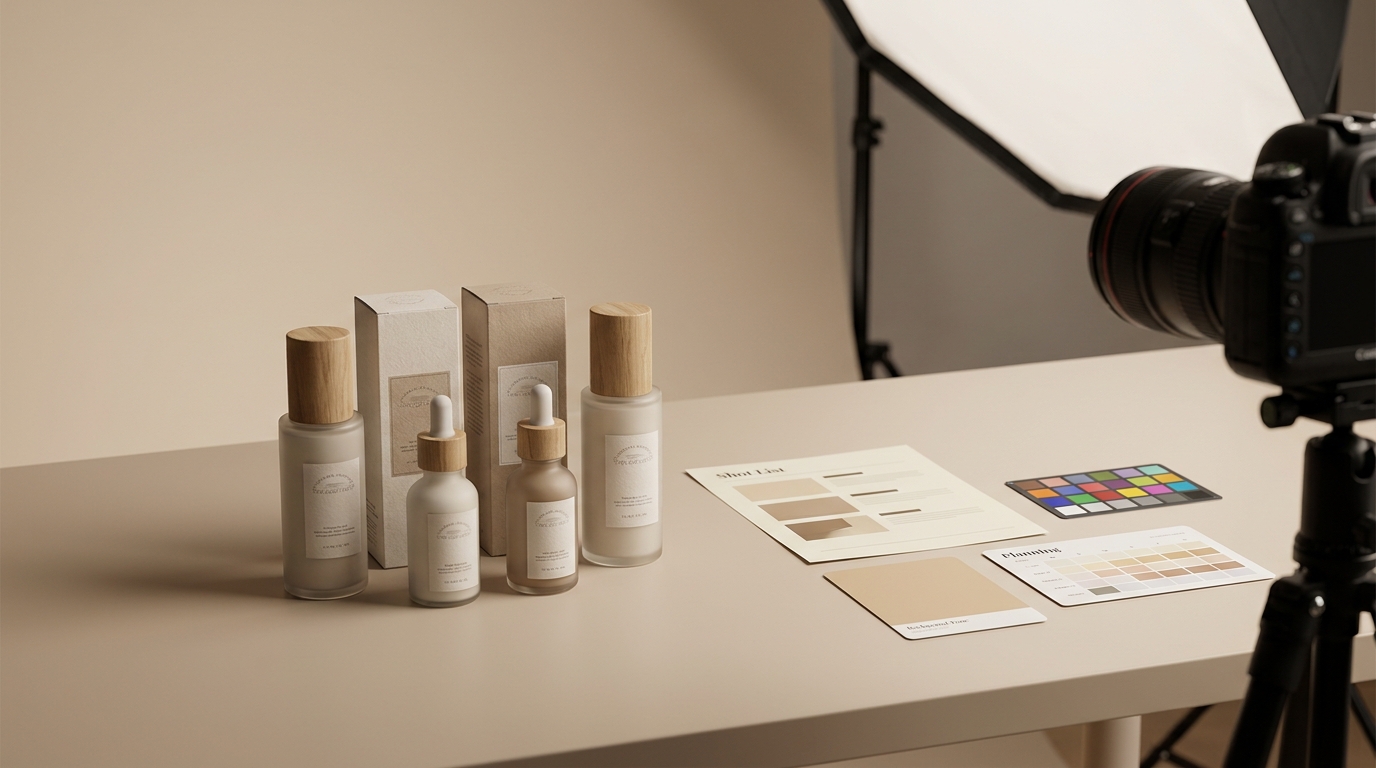
Quick context: Advertflair is the enterprise AI product photography and 3D platform behind 18 months of production at a $5B US retailer, the MBM Chairs 19-video animation program, and Crozier Fine Arts' Art Basel-tier visuals. This piece is about the question every rebrand, seasonal refresh, or catalog expansion starts with: what will the reshoot cost, and when will the images actually be ready? Estimate your reshoot cost and turnaround in 60 seconds →
The two questions every reshoot starts with
If you are staring down a rebrand, a seasonal refresh, or a few hundred new SKUs, two questions come up before anything else: what will the reshoot cost, and when will the images actually be ready? Most teams answer the first one and forget the second. That is a mistake, because on a catalog reshoot the calendar is usually what hurts more than the invoice.
The reason catalog reshoot cost surprises teams is that the per-image rate hides how fast the image count multiplies. A studio quotes a clean number per shot, and then the catalog does the multiplication for you: a 500-SKU furniture catalog at five images each is 2,500 finished images. Add the lifestyle angles, the retailer-spec crops, and the inevitable reshoots when the first pass misses a fabric color, and the count climbs again. The cost adds up fast, and so do the weeks. That is exactly the gap the free Catalog Reshoot Cost and Turnaround Estimator was built to close: it shows the budget and the calendar at the same time.

Why the calendar is the cost nobody budgets for
A studio reshoot is not just a per-image price. It is booking lead time, scheduling around the studio's calendar, the shoot days themselves, and then retouch, in sequence. Each stage is gated by the one before it, so the timeline is additive, not parallel. When a brand asks how long does a product catalog photoshoot take, the honest answer is rarely a few days. It is several weeks to a full quarter once every dependency is counted, and the meter restarts the moment packaging changes or a new variant drops.
That delay is a real cost, even though it never appears on the invoice. Every week a refreshed catalog is not live is a week of selling against stale imagery, and product-page research from the Baymard Institute is blunt about why that matters: shoppers judge product quality primarily through imagery, and incomplete or inconsistent visuals are a leading driver of cart abandonment. Reshoot turnaround time is therefore a revenue variable, not just an operations detail, and it is the one the estimator surfaces alongside the dollars so you can weigh both before you commit.
The data behind the estimator
The estimator is not built on guesswork. Its directional benchmarks come from our production work with mid-market US product companies across furniture and home, food and beverage, industrial, home goods, apparel, beauty, and electronics, the same dataset that anchors our photography cost benchmark. On the AI side, the numbers are grounded in real engagements: across an 18-month program at a $5B US retailer, our Brand DNA pipeline held 98% texture accuracy against the retailer's own studio output while delivering a 60%-plus cost reduction, and it shipped catalog work on a roughly 3-day turnaround rather than a multi-week studio cycle.
Named programs show the same pattern. MBM Chairs produced 19 videos plus a full still-render library from a single CAD source, all reusable, and Crozier Fine Arts ran Art Basel-tier fine-art visuals through the same engine. The throughline is that once a catalog is modeled once, every additional image, fabric, or scene is a render, not a new shoot day. McKinsey's retail and consumer-goods research has repeatedly shown how creative-services costs like reshoots and lifestyle staging hide inside custom-quote pricing, where opacity favors the incumbent vendor, which is precisely the opacity a transparent estimator removes.
What would your reshoot cost — and when would it ship? →
Enter your catalog size, images per SKU, and your studio's real numbers. Get the studio path and the AI path side by side: total cost, total turnaround, and how much sooner you would be in market.
How to use the estimator in three steps
The tool is deliberately simple, and the whole point is that the math is yours to check. It takes about a minute.
Step 1: Enter your catalog size and images per SKU. Start with the real scope, not the product count. If you have 500 products that each need five images, the job is 2,500 images, and that is the number that drives both cost and calendar. This is where most studio quotes quietly understate the bill, because the per-image rate is multiplied by a number the team hasn't worked out yet.
Step 2: Drop in your studio's real numbers, or use the benchmark. If you have your per-image rate, daily output, and typical lead time handy, enter them. If you don't, the estimator pre-loads a directional benchmark by category so you get a usable figure immediately. Every field is editable, so this is a model you can argue with, not a black box.
Step 3: Read the side-by-side. The estimator shows the studio path and the Advertflair AI path together: total cost, total turnaround, and how much sooner you would be in market. The studio path is your lead time plus production at your daily output. The AI path is a short onboarding window plus a much higher daily throughput, because images are generated in parallel instead of set up one at a time. For a fuller cost-only view, the sibling AI photography ROI calculator produces a CFO-ready savings report from the same benchmark.
Why the estimator is free
A fair question about any free tool is what the catch is. There isn't one, and the reason is structurally simple. The hard part of studio vs AI photography cost is not the arithmetic, it is the lack of a transparent baseline, because reshoot and lifestyle pricing live inside custom quotes. Giving away an honest estimator that shows the real numbers is the most direct way we can demonstrate the gap, and it costs us almost nothing to run because it is a calculator, not a service. The brands who find the gap compelling reach out; the ones who don't keep a useful planning tool. That asymmetry is the entire business case for making it free.
It is also why we keep the benchmarks directional rather than dressing them up as a quote. The estimator is a planning instrument for sizing a rebrand photography cost or a seasonal refresh before you commit, and overstating precision would defeat the point. When you are ready for a real number against your real catalog, that is a scoping conversation, and you don't have to bet the whole catalog to start one. The same Brand DNA engine that powers these tools spans catalog stills, interactive 3D, and animation from one model source; the AI Solutions hub shows how those outputs come off a single pipeline, and the vertical pages for fashion and apparel and jewelry show category-specific proof.
Where to start without a big commitment
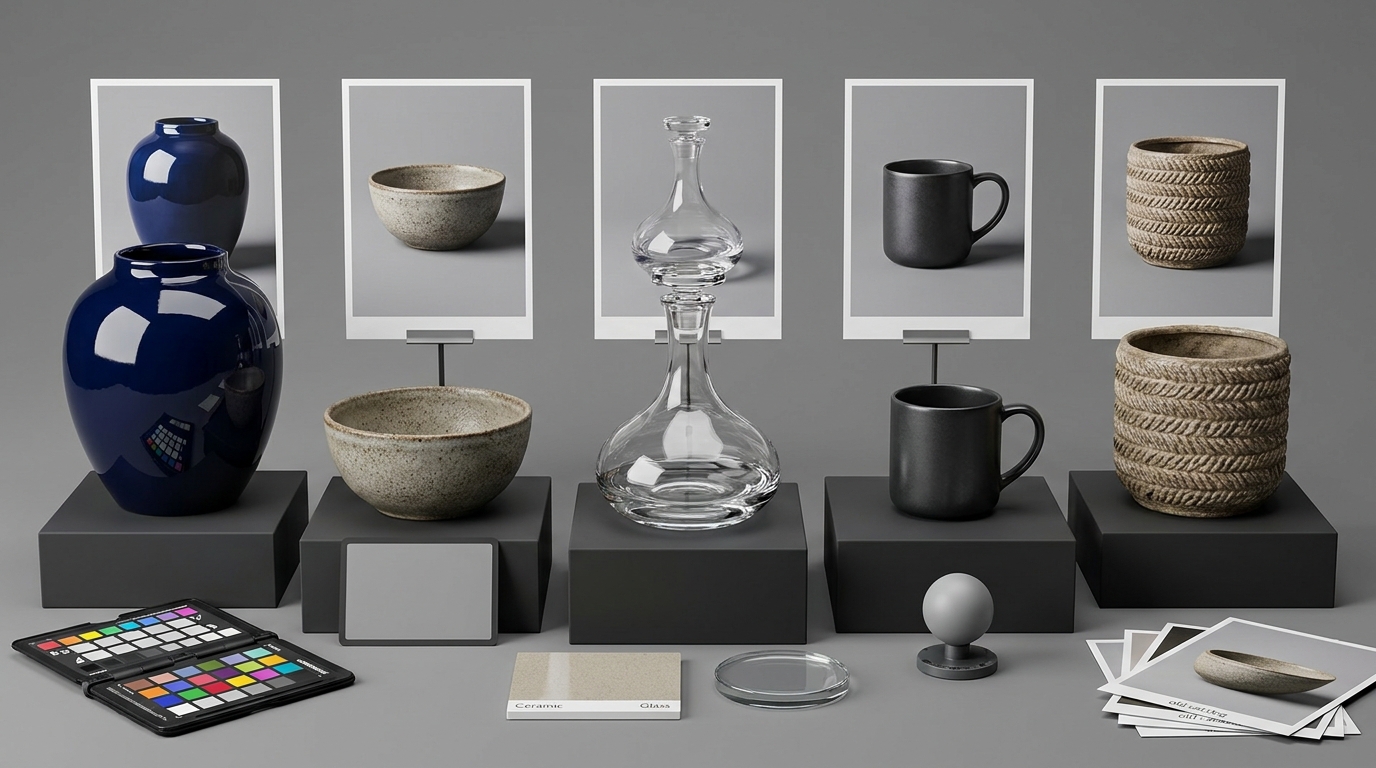
The fastest way to see whether the AI path holds up against your real catalog is a small pilot. Pick five SKUs, ideally your trickiest products and your hero lifestyle scene, run them through the pipeline, and judge the output against your current studio work side by side. Validate fidelity on the SKUs most likely to fail, then scale the catalog with confidence. Run the estimator first to size the full job, then prove the quality on a handful of SKUs before you move the rest.
Estimate the job, then prove it on five SKUs →
Model your reshoot cost and turnaround in about a minute, then start a 5-SKU pilot on your hardest products and your hero scene. Prove the match before you scale.
Open the free estimator → | Start a 5-SKU pilot ($499) → | Book a quick consultation →
Frequently asked questions
How much does it cost to reshoot a product catalog? Traditional studio reshoots usually run from a few hundred to over a thousand dollars per SKU once booking, styling, shooting, and retouching are included, so a 500-SKU catalog at five images each (2,500 finished images) reaches five or six figures plus weeks of lead time. Enter your SKU count, images per SKU, and per-image rate into the estimator to size it for your own catalog. A 5-SKU pilot on your real SKUs starts at $499.
How long does a product catalog photoshoot take? Studio turnaround is booking lead time, scheduling, shoot days, then retouch, in sequence, so a few hundred SKUs commonly take several weeks to a quarter. AI product photography compresses that to a short onboarding window plus high-throughput parallel generation. The estimator shows both timelines side by side.
What is the difference between studio and AI product photography cost? A studio prices per image and re-incurs styling, set-up, and retouch for every SKU and reshoot, so cost grows linearly. AI product photography trains a Brand DNA model once, then renders every SKU through it, collapsing the marginal cost per image. At a $5B US retailer, the AI pipeline delivered a 60%-plus cost reduction at 98% texture accuracy.
Is the estimator free, and how accurate is it? Yes, it is free and needs no signup. It pre-loads directional benchmarks by category, and every input is editable so you can use your studio's real numbers. The benchmarks are directional planning figures from production work with mid-market US product companies, not a binding quote.
How do I reduce catalog reshoot cost without sacrificing quality? Price the true image count (SKUs times images per SKU times expected reshoots), not the product count, then test an AI-native pipeline on a small pilot of your hardest SKUs and judge it against your studio work side by side. Validate quality before you commit the full catalog.
Hari Gurusamy
Founder & CEO, Advertflair (DBA Vela Studio, Glam AI, Style AI)
Hari founded Advertflair in 2016 and led the pivot from a 145-person 3D services firm to a 25-person enterprise AI product photography platform. The Brand DNA engine he and the team built has run in production at a $5B US retailer for 18 months, on the MBM Chairs 19-video animation program, and on Crozier Fine Arts' Art Basel-tier visuals. Connect with Hari on LinkedIn.


